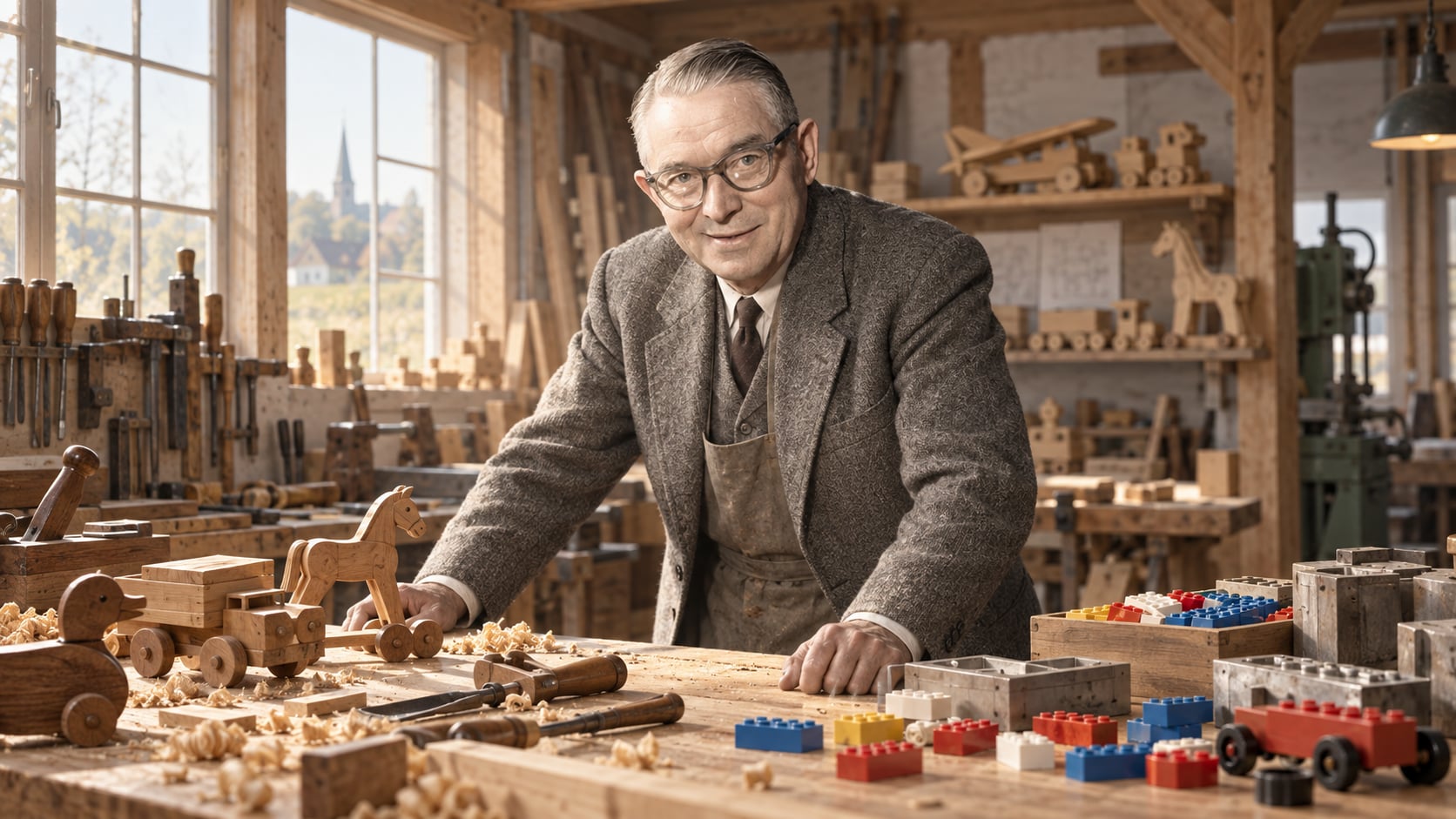
- He made Godtfred return a shipment of wooden ducks over one missing coat of varnish.
- He won the naming contest he held for his own employees, calling the winning entry LEGO after nearly choosing LEGIO instead.
- His family still controls the business today through a private holding company worth a combined $25 billion.
Who was he—and what was he like before everyone noticed?
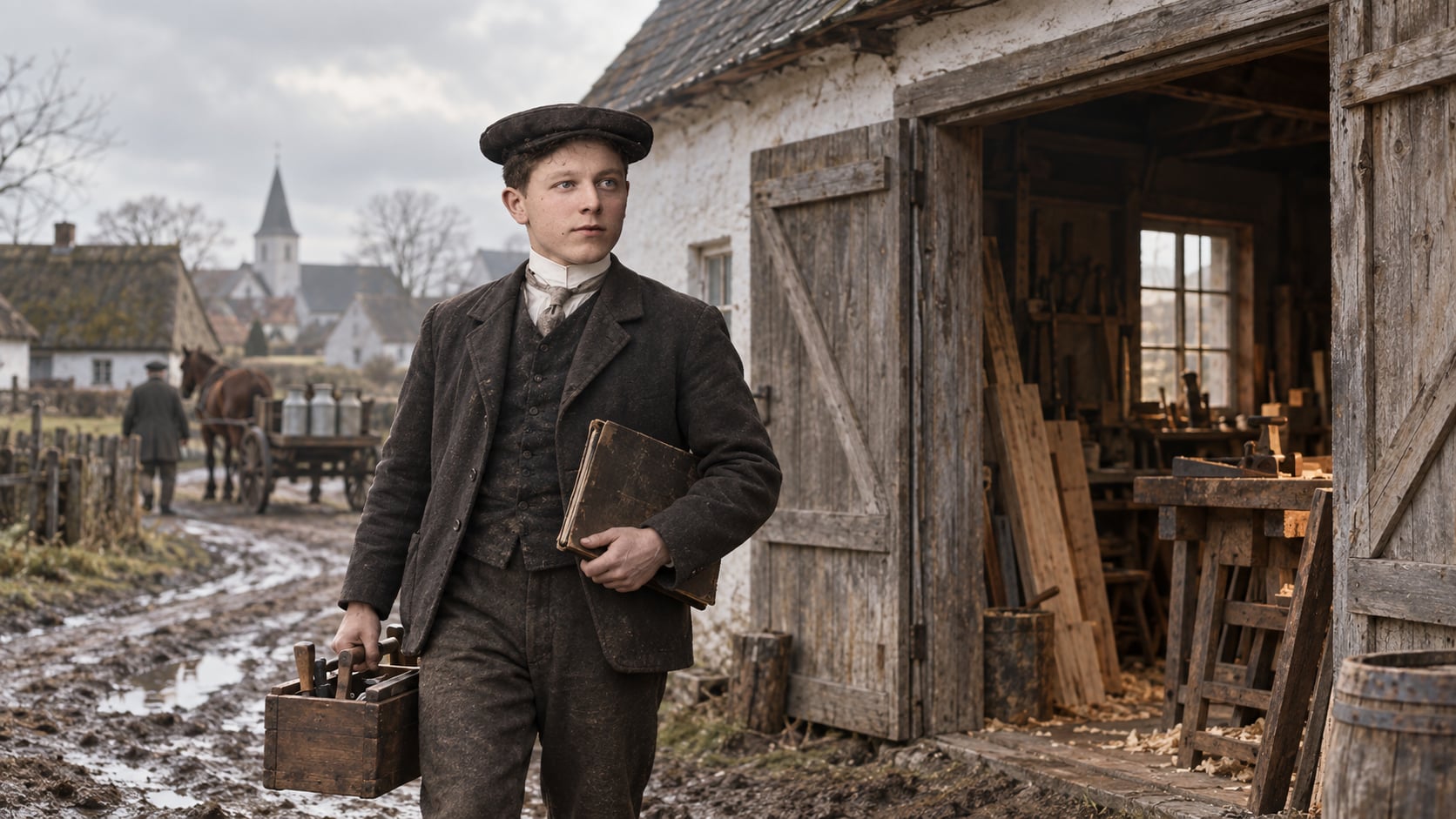
Ole Kirk Christiansen was a journeyman carpenter who'd worked his way across Denmark and Germany before he had a business of his own. On February 1, 1916, at 24, he bought a small woodworking shop in Billund1, then a hamlet of a few farms, a dairy, and an inn, for 10,000 kroner he didn't fully have.
What did his life look like before his trek began?
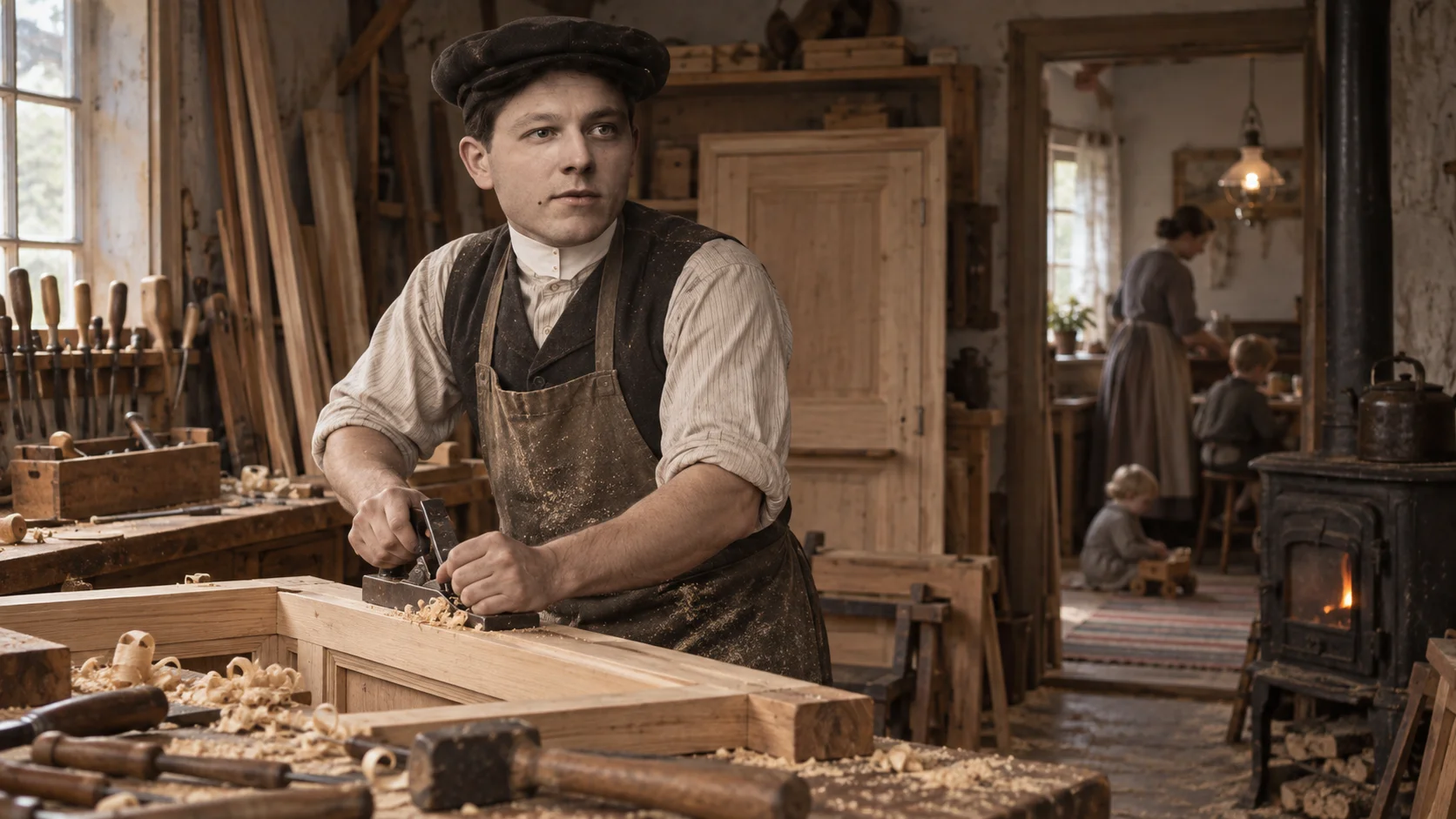
The shop built what a farm town needed: doors, window frames, kitchen cabinets, coffins, cart bodies, the occasional barn or church. He married Kristine Sørensen the same year he bought the workshop, and by the early 1920s they had four sons: Johannes, Karl Georg, Godtfred, and Gerhardt, running a household around a business that was, at best, breaking even.
What did he see that other people didn't?
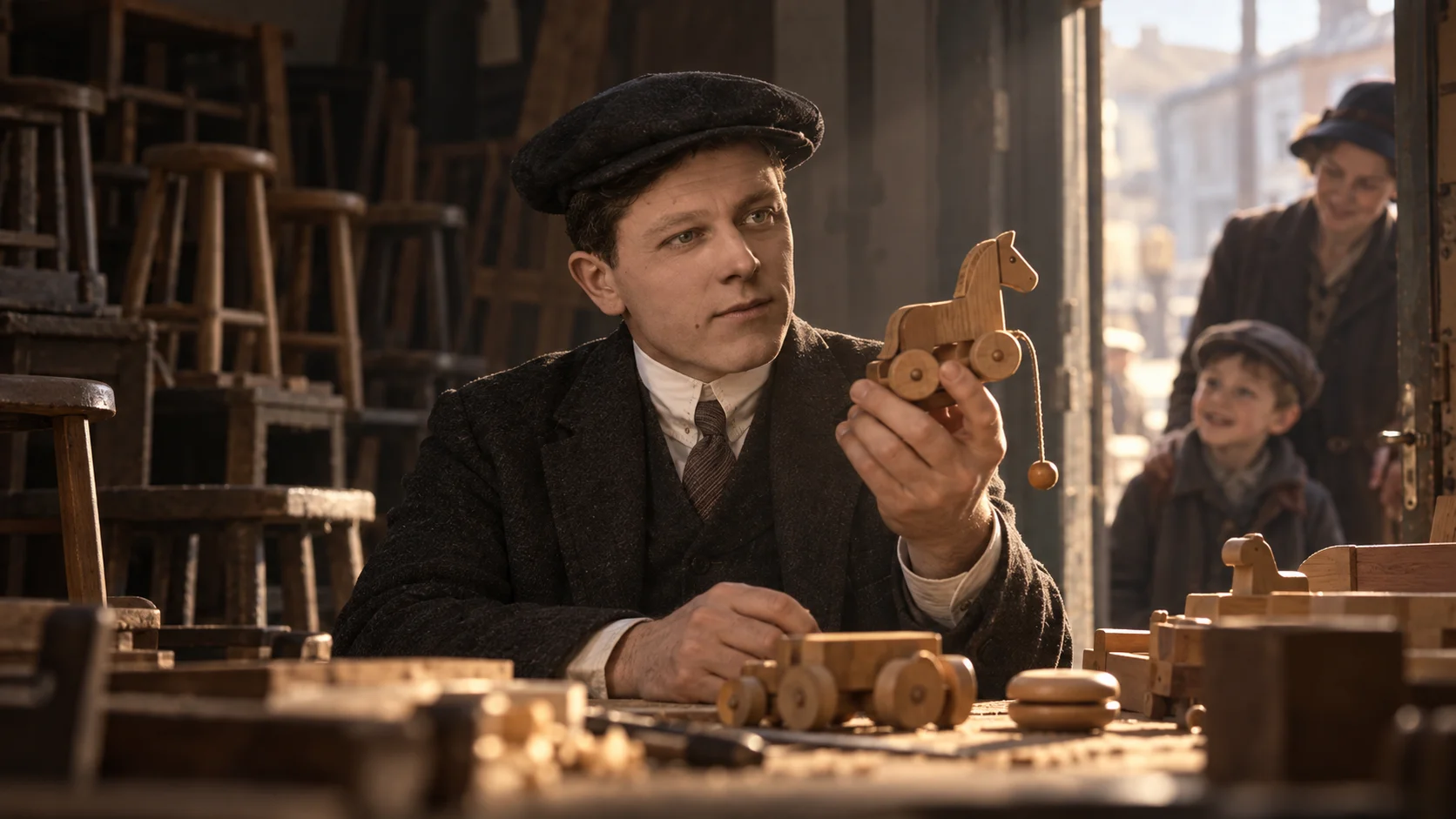
That a carpenter with no customers for ladders could still have customers for toys. When the Depression drove down farm prices in the early 1930s, nobody was buying stepstools or ironing boards. Christiansen noticed that children still wanted things to play with, recession or not, and started building wooden cars, yo-yos, and pull-along animals alongside the furniture no one could afford.
What problem became his obsession?
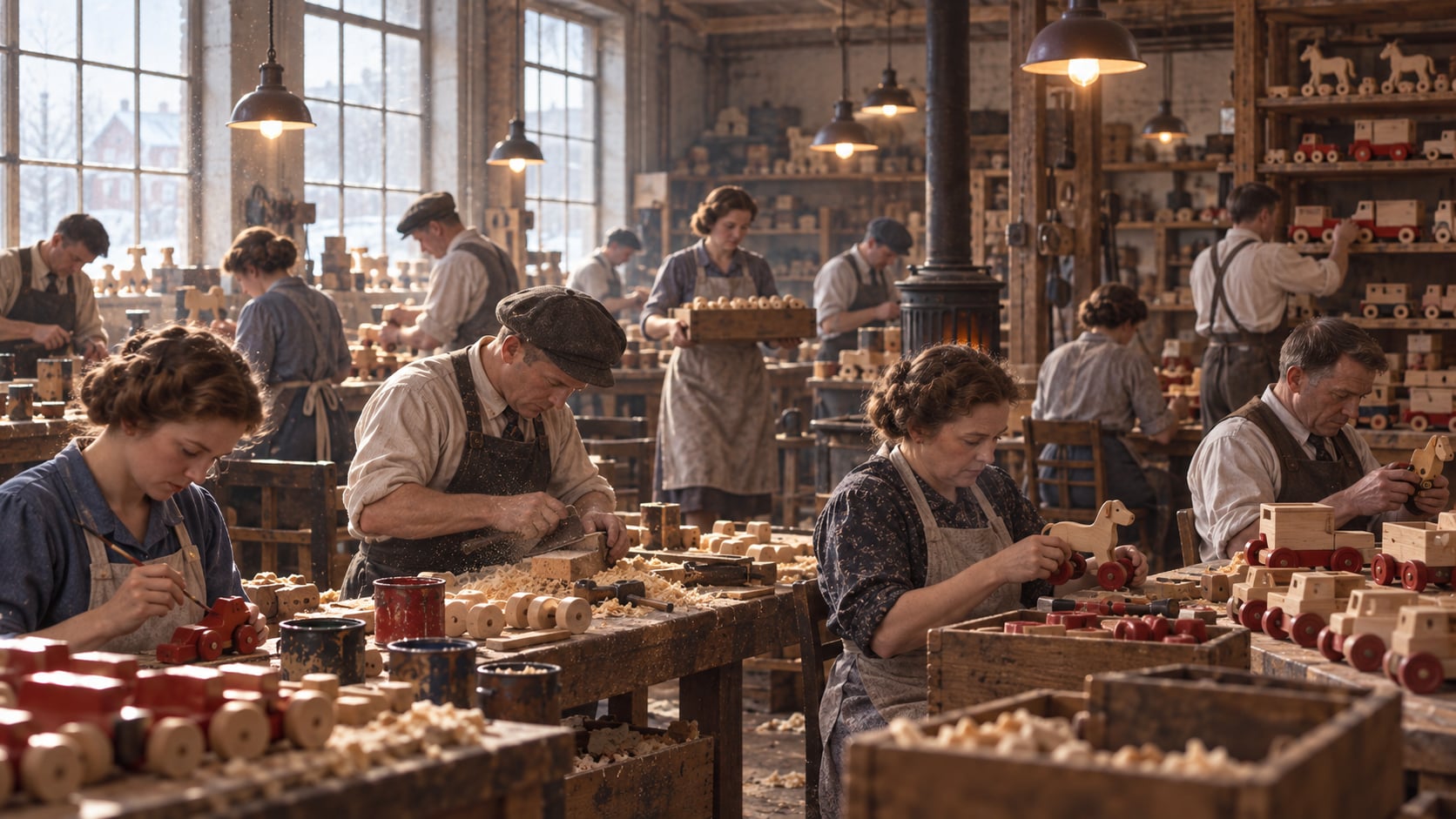
Keeping a dozen employees paid through a decade that kept trying to shut him down. Toys were the one product line anyone still had money for, and once he'd committed to them, he ran the workshop as if quality were the only thing keeping it alive. It was.
Why did this matter personally to him?
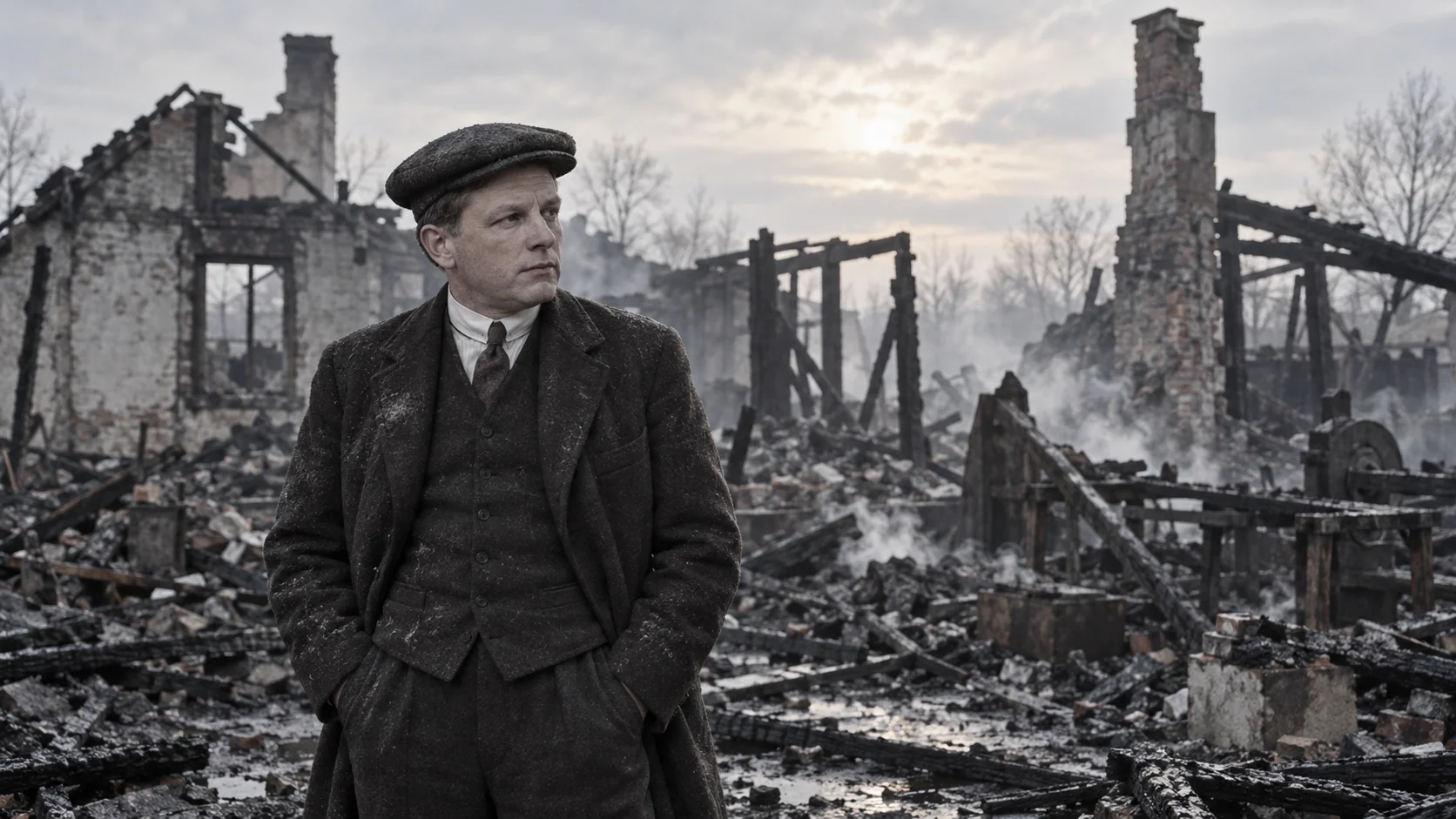
He'd already lost the shop once. A fire in 1924, when his own sons had been trying to light a glue-heating machine and set the wood shavings off instead, burned down the workshop and the family home in the same afternoon. He rebuilt it by hand. Losing the business a second time, to a recession instead of a spark, was a risk he treated as seriously as the first.
Where did the first money come from?
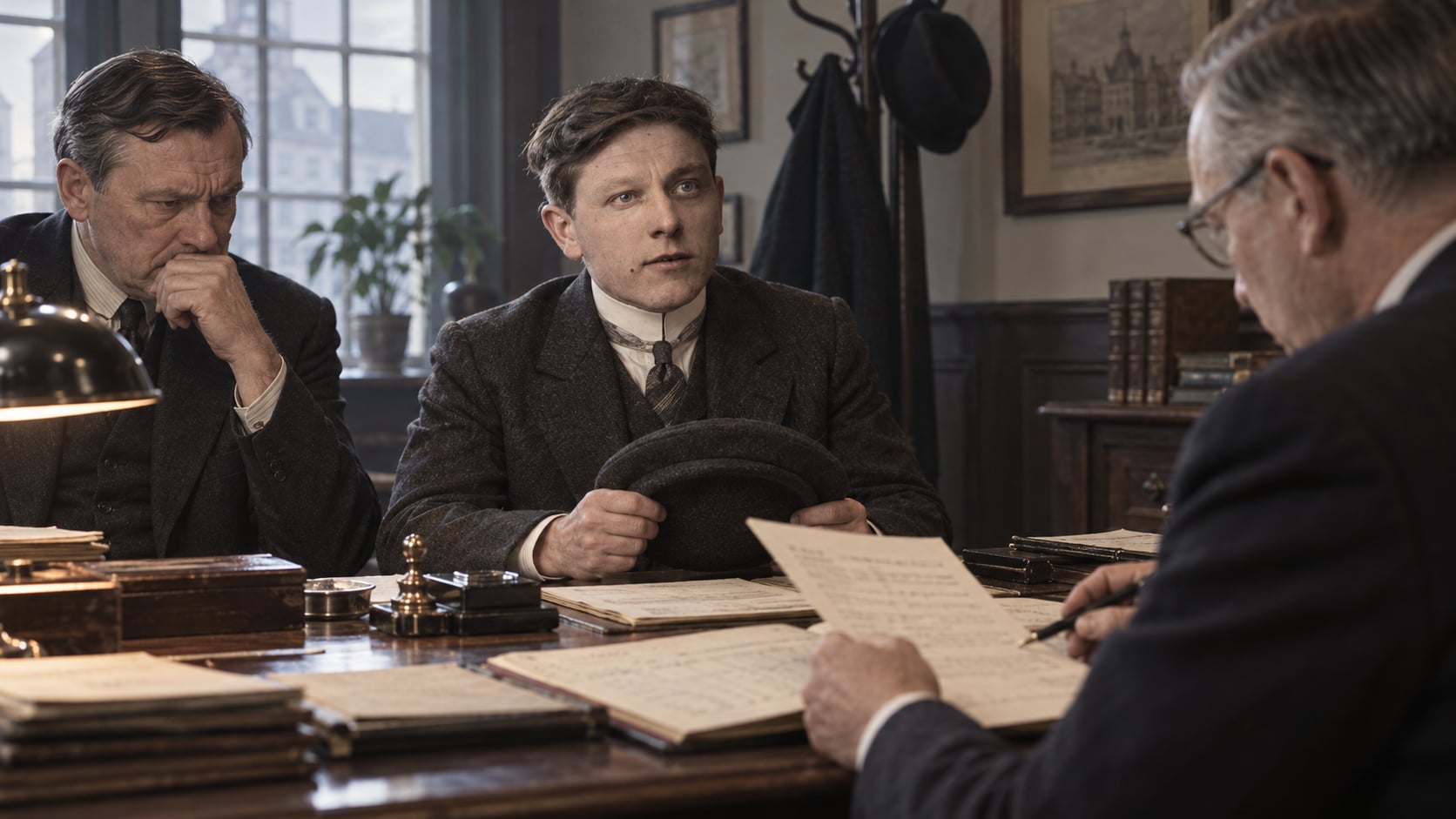
Everything he had, plus a loan he had to beg relatives to guarantee. He needed 3,000 kroner to keep the shop running through the toy pivot, and one relative, asked to co-sign it, put it to him directly: "Can't you find something more useful to do?" He took the loan anyway, and paid it back with interest by 1939.
What made the economics work?
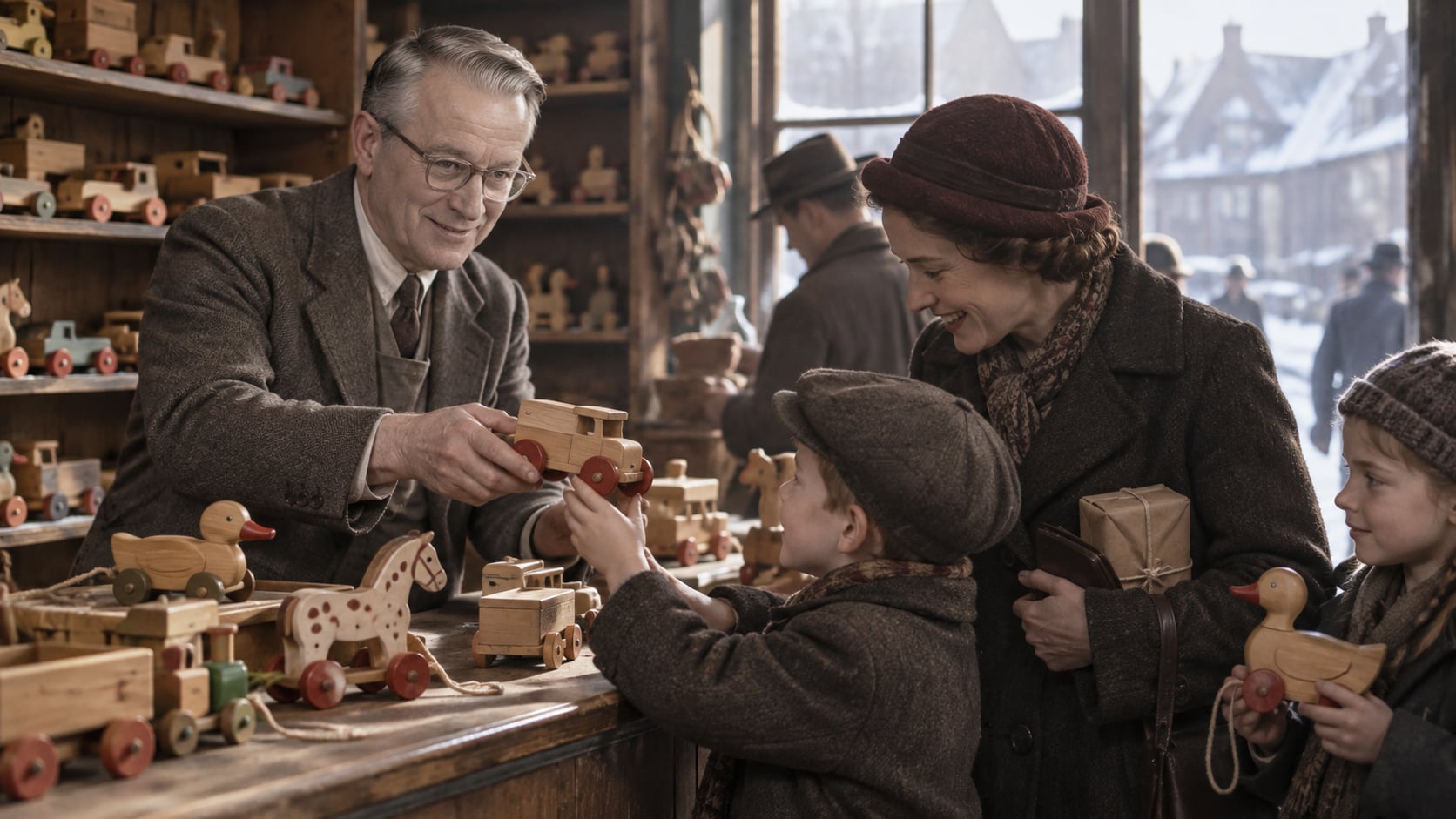
Wooden toys were cheap enough for a Depression-era customer to still afford, and durable enough that Christiansen's name traveled with them. He had no marketing budget, only a workshop's reputation for not cutting corners, and in a town that small, that was the only advertising that mattered.
What was the decision or moment after which nothing was the same?
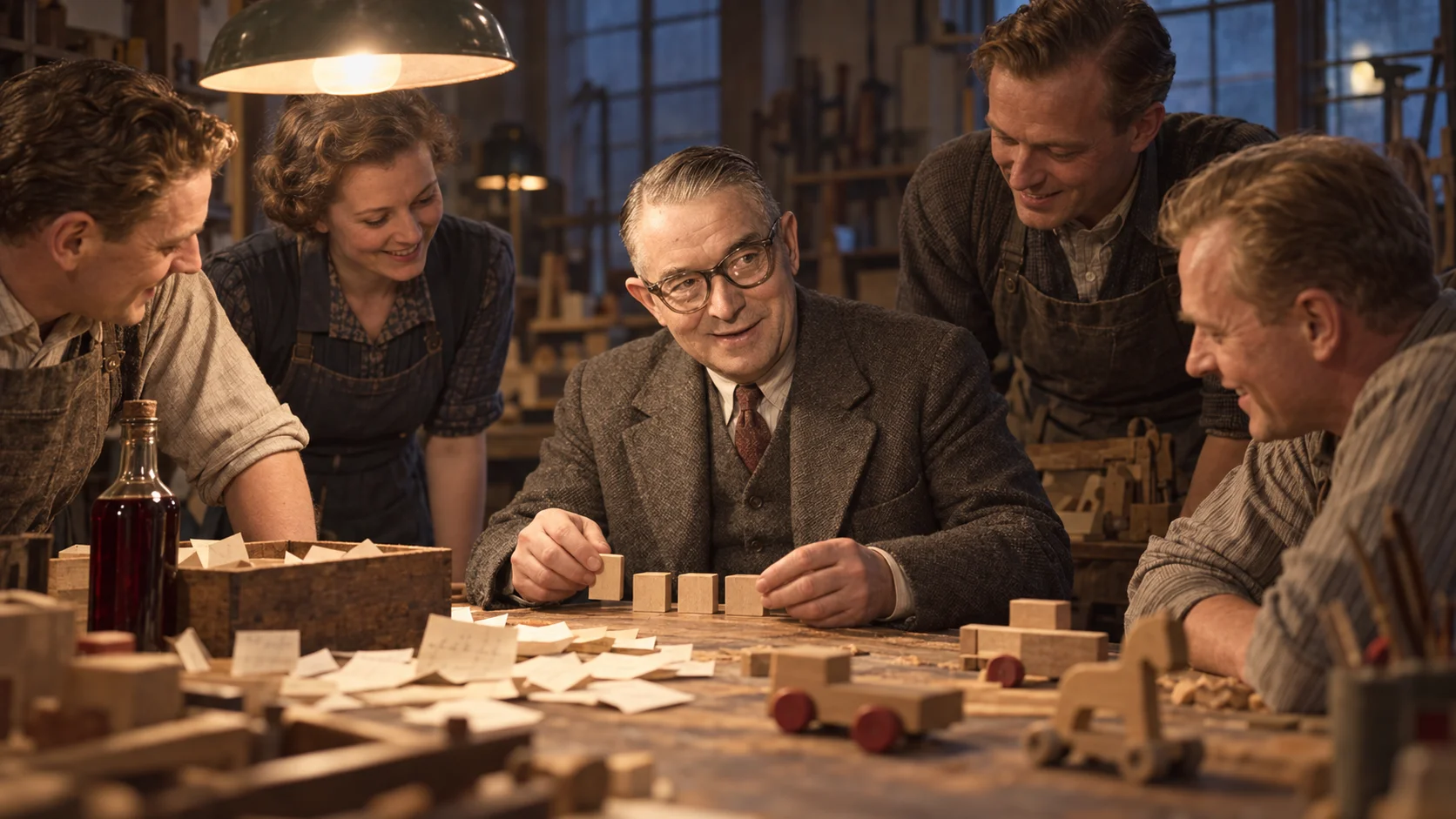
Late 1935, when he decided to stop treating toys as a side business and commit the whole shop to them. He renamed the company that January, and the new name came from a contest he held among his own employees. The prize was a bottle of his homemade fruit wine, and he won it himself, combining the Danish "leg godt," meaning "play well," into a single word: LEGO2.

What nearly killed it?
Fire, a second time. A short circuit on March 20, 1942, burned the factory to the ground: stock, tools, blueprints, all of it, though the house next door survived. Christiansen considered walking away. He didn't. With a bank loan and family help, he rebuilt again, and by the end of the year the shop had grown to 40 employees instead of shrinking to zero.
What happened that he couldn't have planned for?
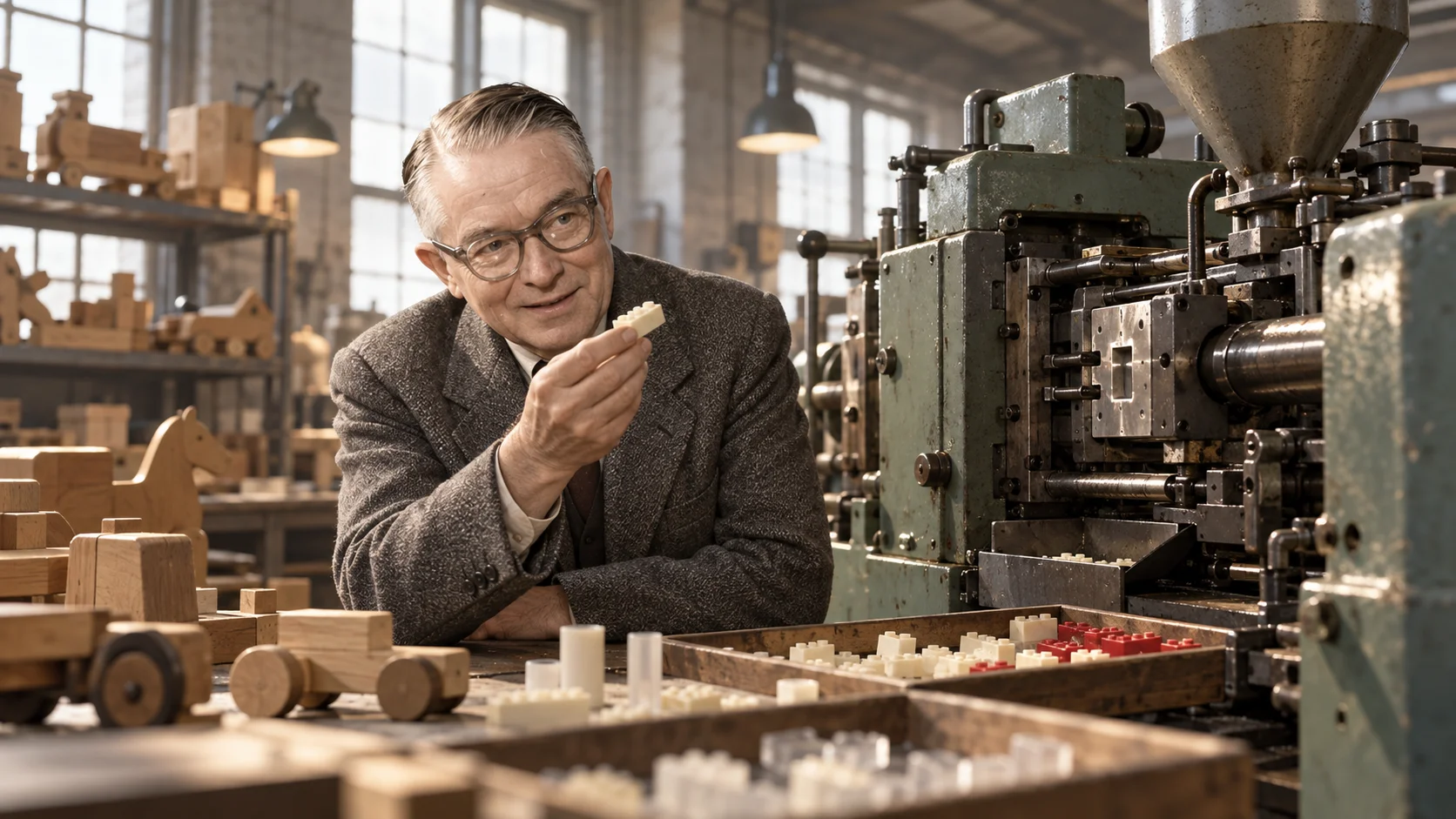
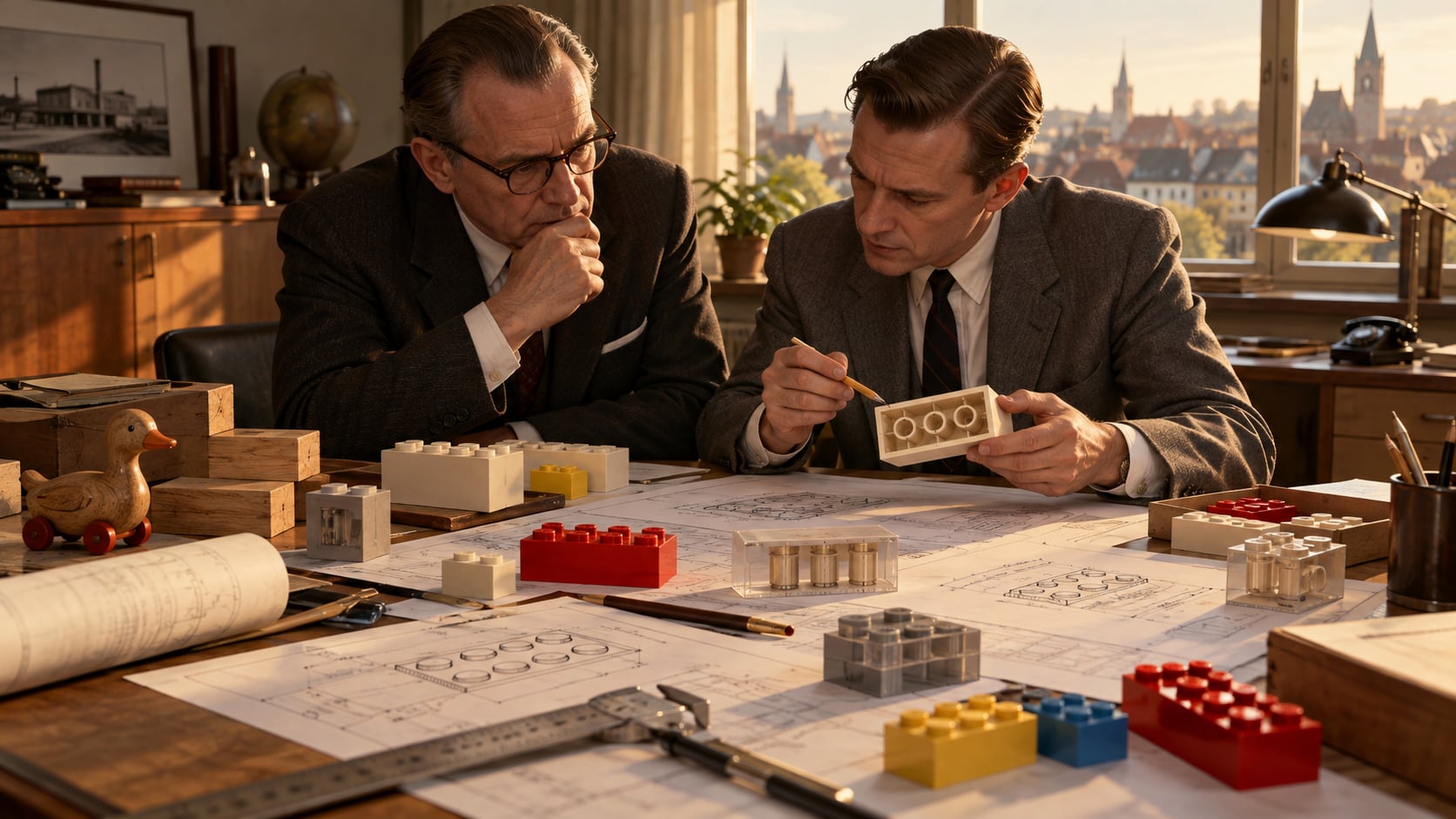
Plastic. In 1947 he bought Denmark's first plastic injection-molding machine, an English-made Windsor SH, mostly to see what it could do alongside wood. Two years later the shop was producing "Automatic Binding Bricks,"3 small plastic blocks modeled closely on a British design by the toy designer Hilary Page. Nobody, including Christiansen, yet understood they'd outlast every wooden toy the company had ever made, and it would take his son Godtfred until 1958 to redesign the brick's underside with hollow interlocking tubes4—the change that finally made two bricks want to stay together.

What showed that he was human after all?
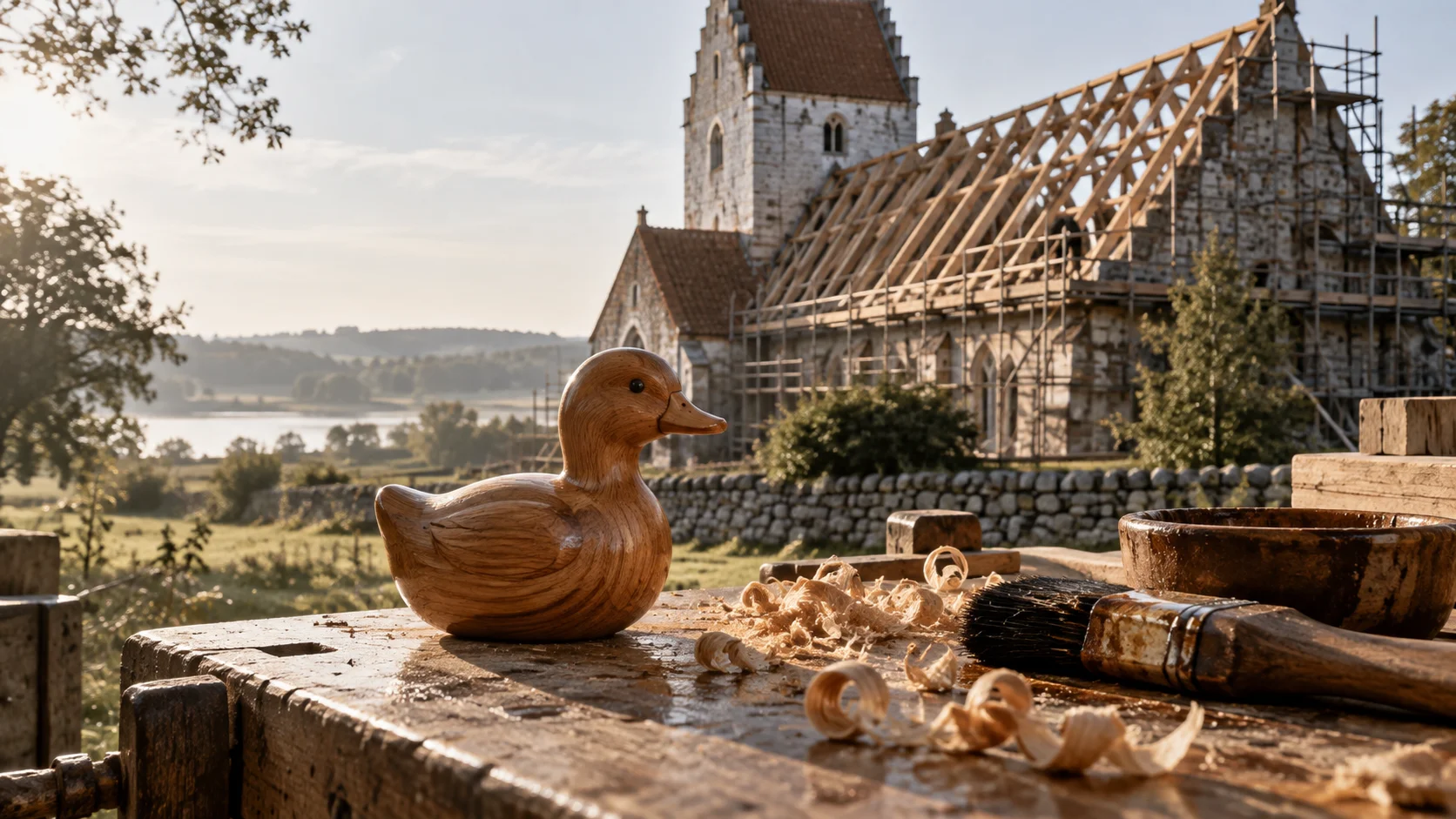
His son Godtfred once shipped a batch of wooden pull-along ducks with two coats of varnish instead of the usual three, to save time during a lean stretch. Christiansen found out before the ducks left the train station, made Godtfred bring them back, and had him apply the missing coat before they went anywhere5. The line that came out of it, that only the best is good enough, outlived the ducks by nearly a century.
What was the change he brought about?
By 2000, Fortune magazine and the British Association of Toy Retailers had both independently named LEGO "Toy of the Century"6, and by 2015 the company Christiansen started in a carpentry shop had overtaken Mattel to become the largest toy manufacturer in the world by revenue.
What did he believe that most reasonable people around him did not?
That the workday itself belonged to something larger than the production schedule. From 1955 to 1960, every shift at the Billund plant opened with Christiansen reading scripture to the assembled staff in the factory canteen7, followed by a hymn from LEGO's own songbook—a devotion built into a toy factory's morning, not kept separate from it.
What did his trek cost him?
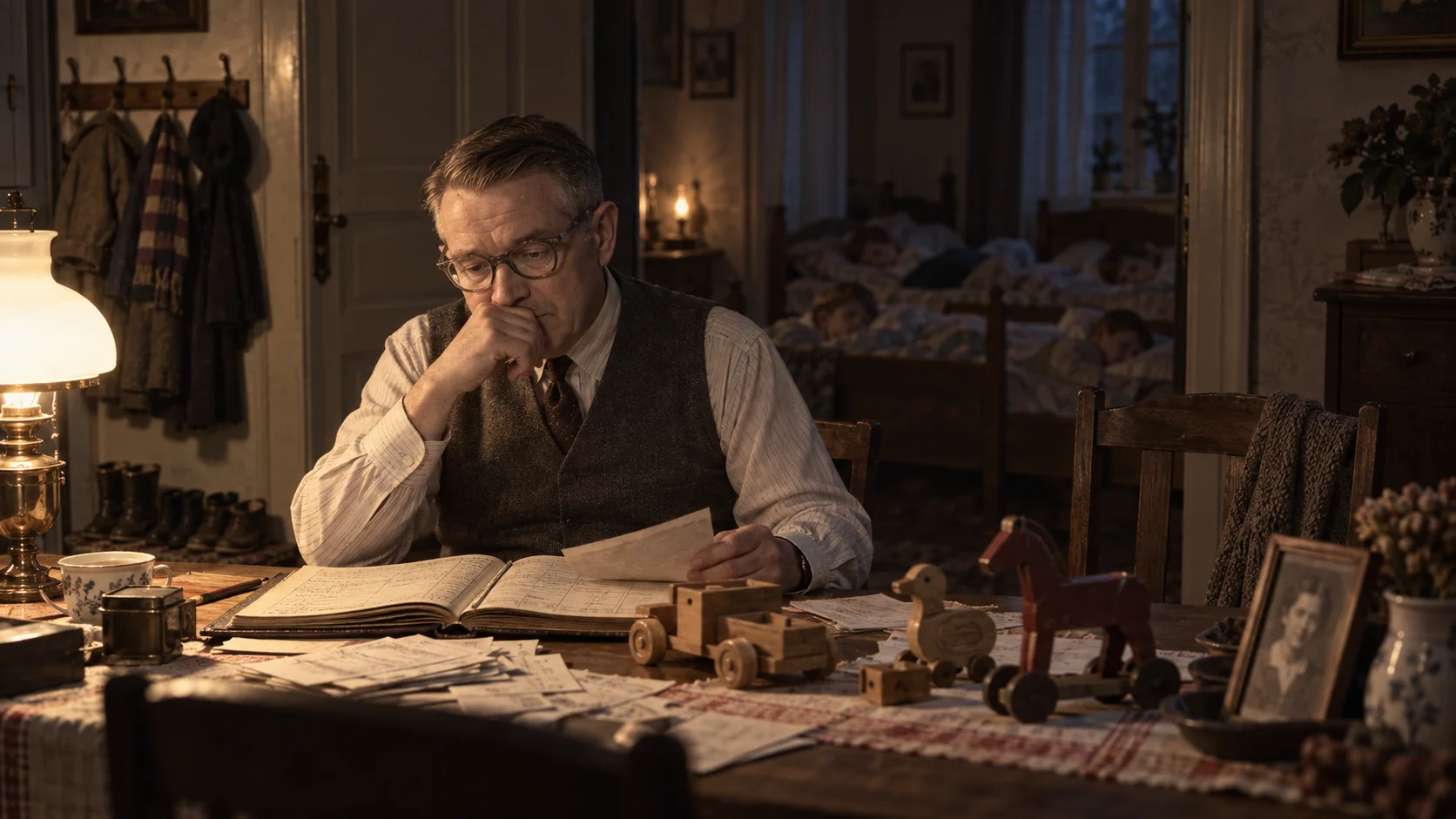
His first wife, Kristine, died in 1932, in the middle of the years he was fighting hardest to keep the business alive, leaving him to raise four young sons and run the shop at once. He remarried two years later, to Sofie Jørgensen, but the stretch in between, rebuilding a company and a household on the same ledger, was his alone to carry.
What's the takeaway?
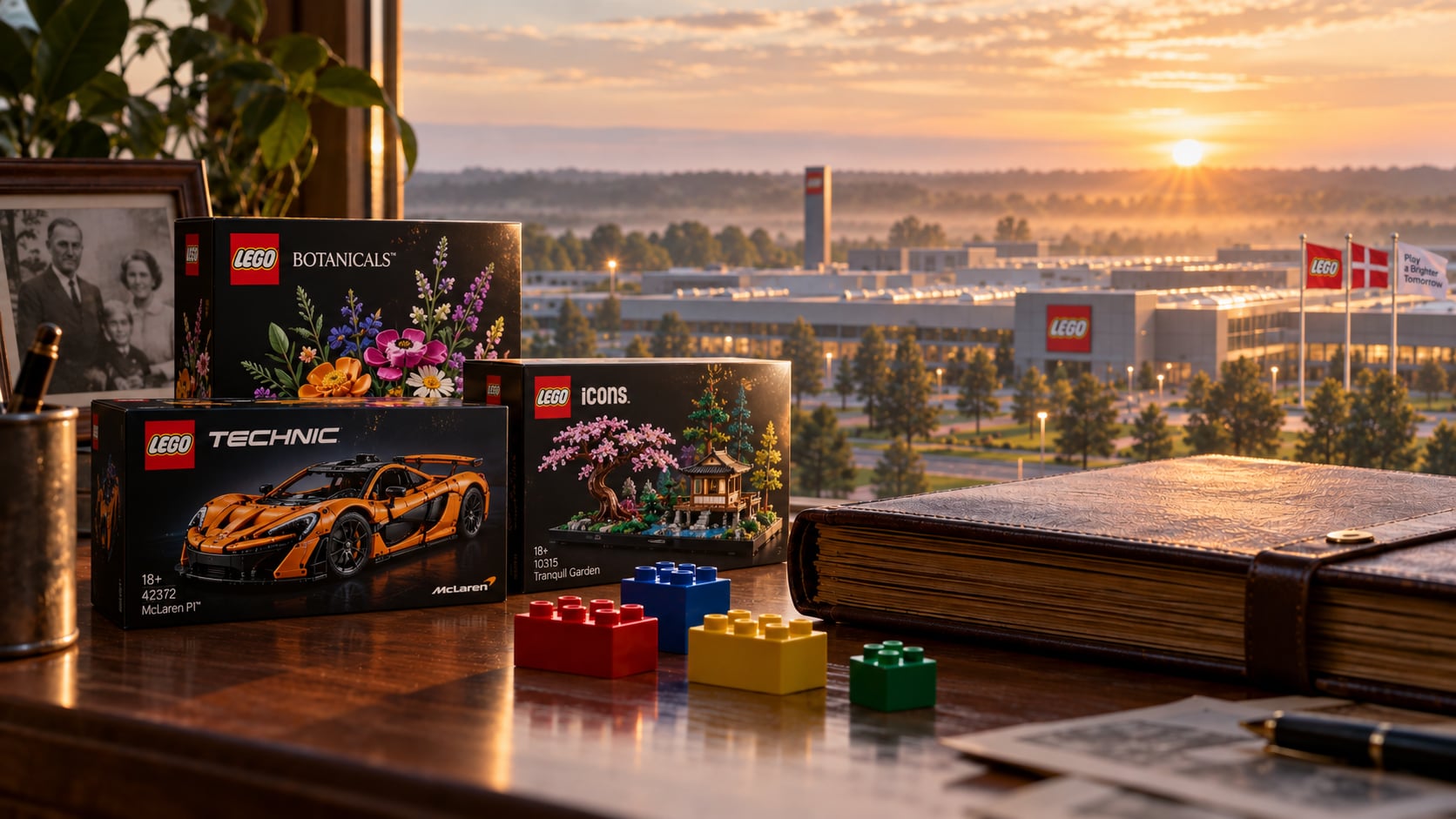
He never let "good enough for now" become good enough for good—not in a Depression, not after two fires, and not when it would have been easiest to let it slide. Christiansen died on March 11, 1958, six weeks after Godtfred filed the patent that would define the company for the next century; the family he started it for still runs it today8.
Timeline
-
1891—Born April 7, in Filskov, Denmark.
-
1916—Buys a carpentry workshop in Billund, at 24; marries Kristine Sørensen.
-
1924—A fire destroys the workshop and the family home.
-
1932—Pivots the shop to wooden toys as the Depression collapses demand for furniture; his wife, Kristine, dies the same year.
-
1934—Remarries, to Sofie Jørgensen.
-
1936-01—Renames the company LEGO, from the Danish "leg godt."
-
1942-03—A second fire destroys the factory; rebuilt by year's end.
-
1947—Buys Denmark's first plastic injection-molding machine.
-
1949—Begins producing Automatic Binding Bricks, the company's first plastic interlocking blocks.
-
1958-01—Son Godtfred designs the stud-and-tube brick; the patent is filed January 28.
-
1958-03—Dies March 11, in Billund, at 66.
Side notes
-
Billund, then and now—The hamlet Christiansen bought into in 1916 counted roughly 250 residents by 1930. Today Billund is home to LEGO's global headquarters, an airport that moves more than 3 million passengers a year, and LEGOLAND, which draws some 2 million visitors annually. Learn more ↩
-
The name LEGO—Christiansen had briefly considered LEGIO before settling on LEGO. He only discovered afterward, by coincidence, that the word also translates from Latin as "I gather" or "I put together," a meaning that arrived well after the name did. Learn more ↩
-
Automatic Binding Bricks—Page's Self-Locking Bricks were patented in the United Kingdom in 1940, nine years before Christiansen's shop began producing its own version. Decades later, in a 1986 Hong Kong court case, Godtfred testified under oath that LEGO had copied the English bricks "very carefully"—the first time anyone at the company had said so on the record. Learn more ↩
-
The 915,103,765 number—LEGO's own account of the 1958 patent filing says the redesigned stud-and-tube coupling let six standard 2x4 bricks combine in exactly that many different ways. Learn more ↩
-
The wooden duck—LEGO House turned the story into a physical object in 2020, releasing a limited-edition wooden pull-along duck set as its own tribute to the varnish incident that shaped the company's motto. Learn more ↩
-
Toy Hall of Fame first—Two years before either "Toy of the Century" vote, LEGO was among the first toys inducted into the U.S. National Toy Hall of Fame when it opened in 1998. Learn more ↩
-
The LEGO Cross—In the years the devotions ran, Christiansen also had the company mold small glow-in-the-dark plastic crosses, given to employees as Christmas gifts in the 1940s and later sold to help fund one of Denmark's first youth sports schools. Learn more ↩
-
Kirkbi's other bets—Beyond its roughly 75 percent of LEGO, the family holding company owns nearly half of Merlin Entertainments, the operator behind LEGOLAND, Madame Tussauds, and dozens of other attractions worldwide, taken private alongside Blackstone in 2019 for $7.6 billion. Learn more ↩