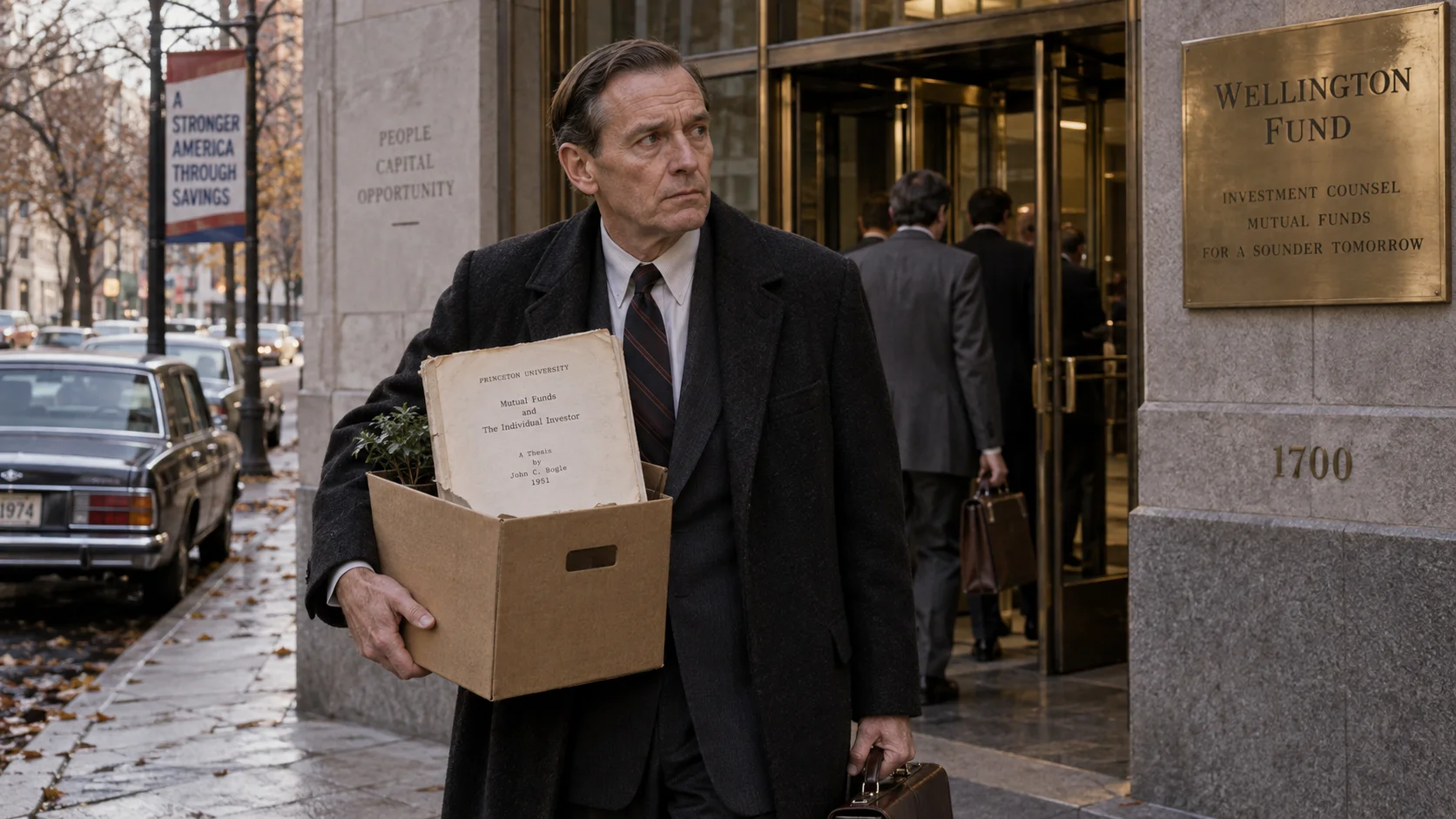
- Fired at 45 from the only firm he had ever worked for.
- Launched an index fund the industry dismissed as un-American and doomed to fail.
- Gave up the ownership stake that would have made him a billionaire.

Who was he—and what was he like before everyone noticed?
John Clifton Bogle was born May 8, 1929, in Montclair, New Jersey, with a twin brother, David. He was a Princeton scholarship student hunting for a thesis topic nobody had written on, and picked the mutual fund industry because a Fortune article had left no academic study behind it. He had no family money and no capital—only a 130-page paper.

What did his life look like before his trek began?
He worked his way through Princeton, and that thesis was the whole of his prospects. Finished in 1951, it argued that funds should serve their shareholders rather than their managers, and shouldn't claim to beat the market. It reached Walter L. Morgan, founder of the Wellington Fund1, who hired him on graduation.
What did he see that other people didn't?
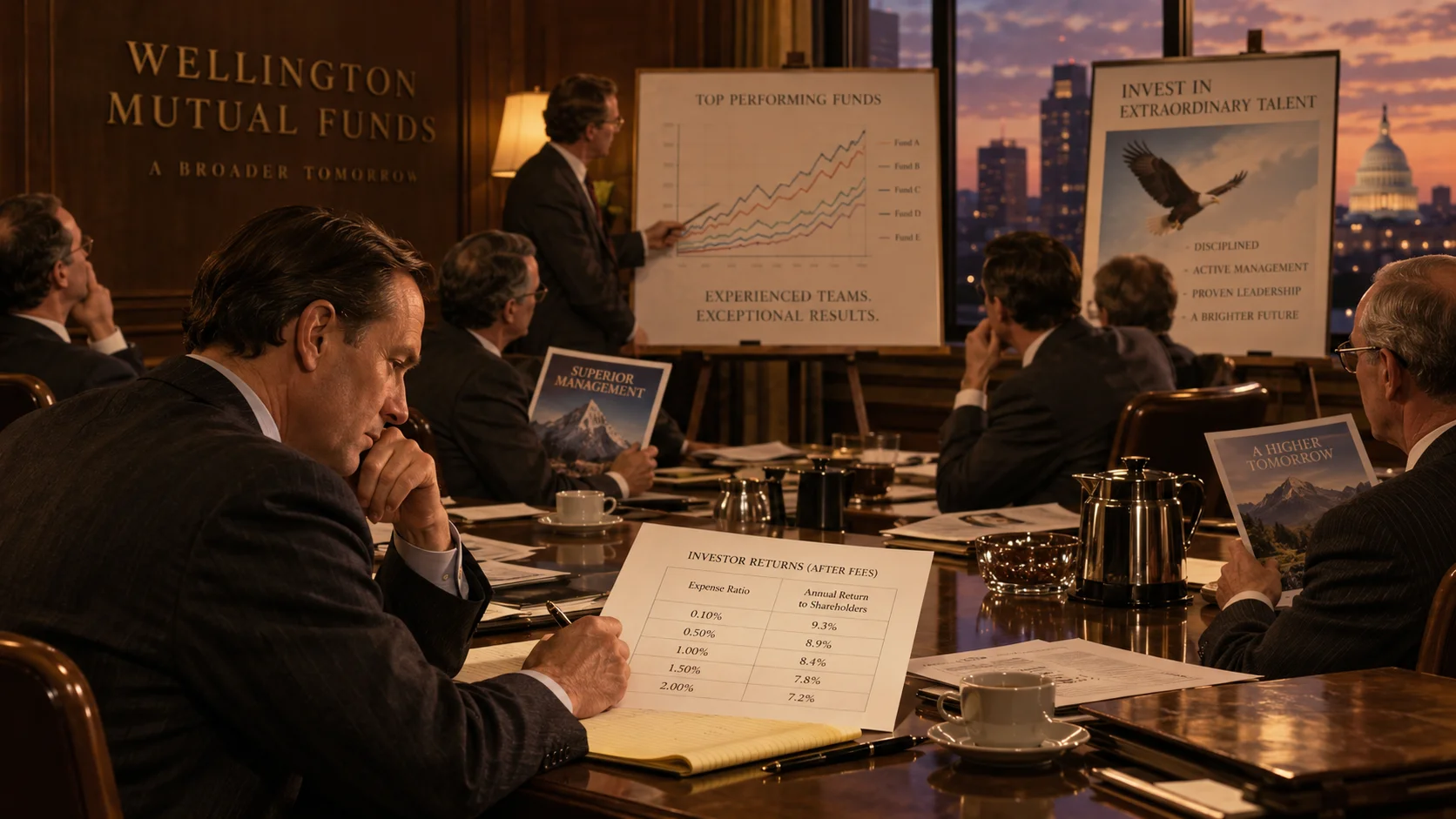
That the cost of investing was the one variable that reliably determined what a shareholder kept. The industry sold skill and charged for it whether the skill showed up or not; the charge was the only part guaranteed to arrive. Economist Paul Samuelson's 1974 challenge to the industry2 argued that professional managers rarely beat a simple index—an argument Bogle later built into a fund.
What problem became his obsession?
How to give an ordinary investor the market's return without paying someone to try to beat it—and, harder, how to build a company that wouldn't eventually be pulled toward charging more anyway. A low-cost fund inside a normal, profit-seeking firm still has shareholders pushing to raise the fee.
Why did this matter personally to him?
He'd argued it in writing at 22, before he had a career to protect by saying it, then spent two decades working inside a firm built on the opposite premise. Every year at Wellington was, in effect, an argument against his own thesis.

Where did the first money come from?
There was no first money, and that's the unusual part. Vanguard was carved out of the firm that had just dismissed him, an administrative company owned by the funds themselves rather than by him. He put in no capital and took no equity in it.

What made the economics work?
Vanguard is owned by its member funds, which are owned by fund shareholders—a structure the company still describes in exactly those terms3. With no outside owner to pay, scale returns to shareholders as lower fees instead of profit: fees cut more than 2,000 times since 1975.
What was the decision or moment after which nothing was the same?
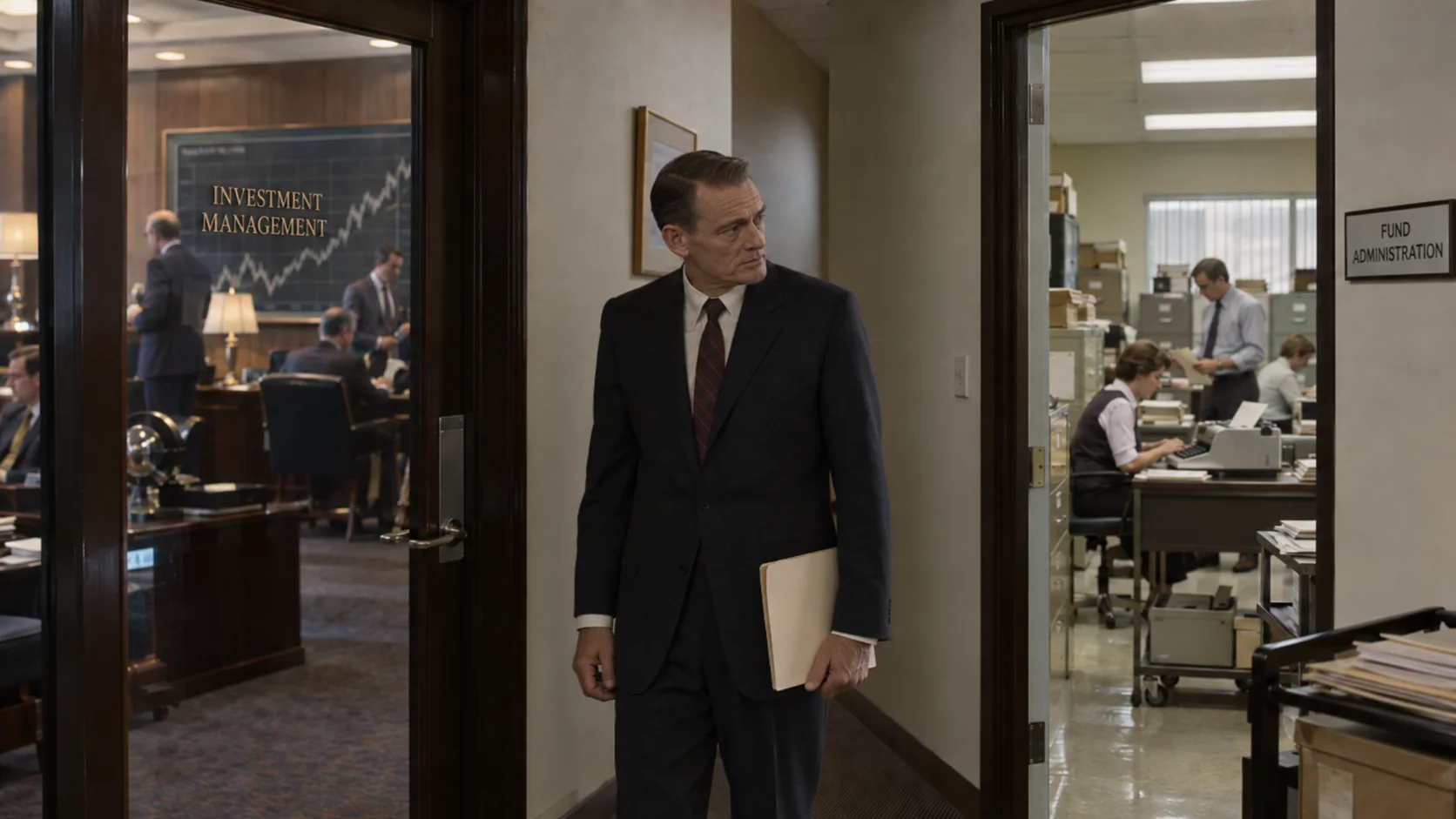
1974: dismissed from Wellington for approving a merger he later called extremely unwise, the split left him running fund administration but barred from managing client money—the restriction that left him nothing to sell but cost, and built the company that outlasted the firm which fired him.
What nearly killed it?
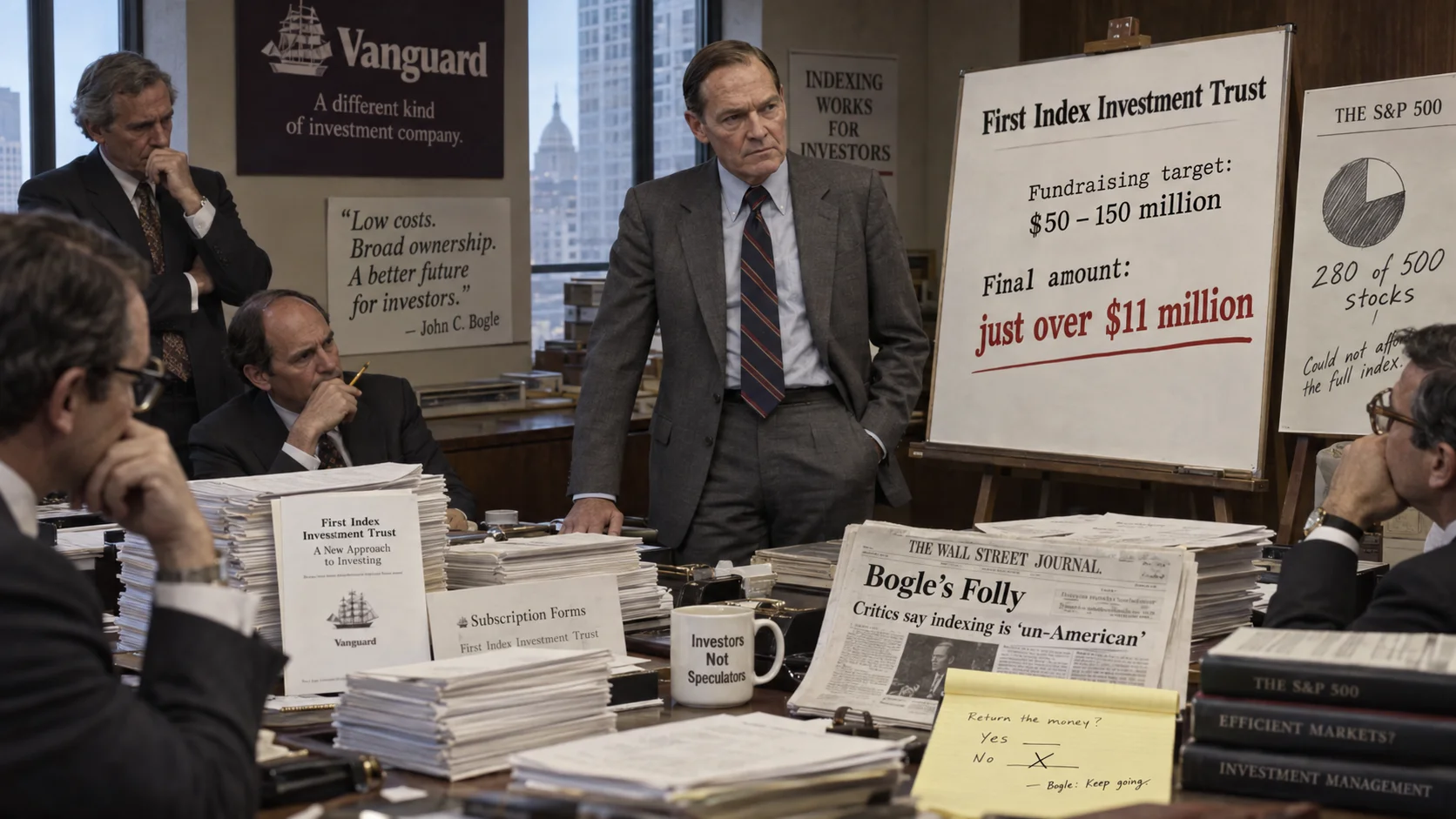
The first index fund was a failure on arrival. First Index Investment Trust sought $50–150 million and raised a little over $11 million—Bogle's own words were "an abject failure." It couldn't afford all 500 stocks in the index and bought 280. Underwriters proposed giving the money back; he refused. The industry called it Bogle's Folly4 and indexing un-American.
What happened that he couldn't have planned for?
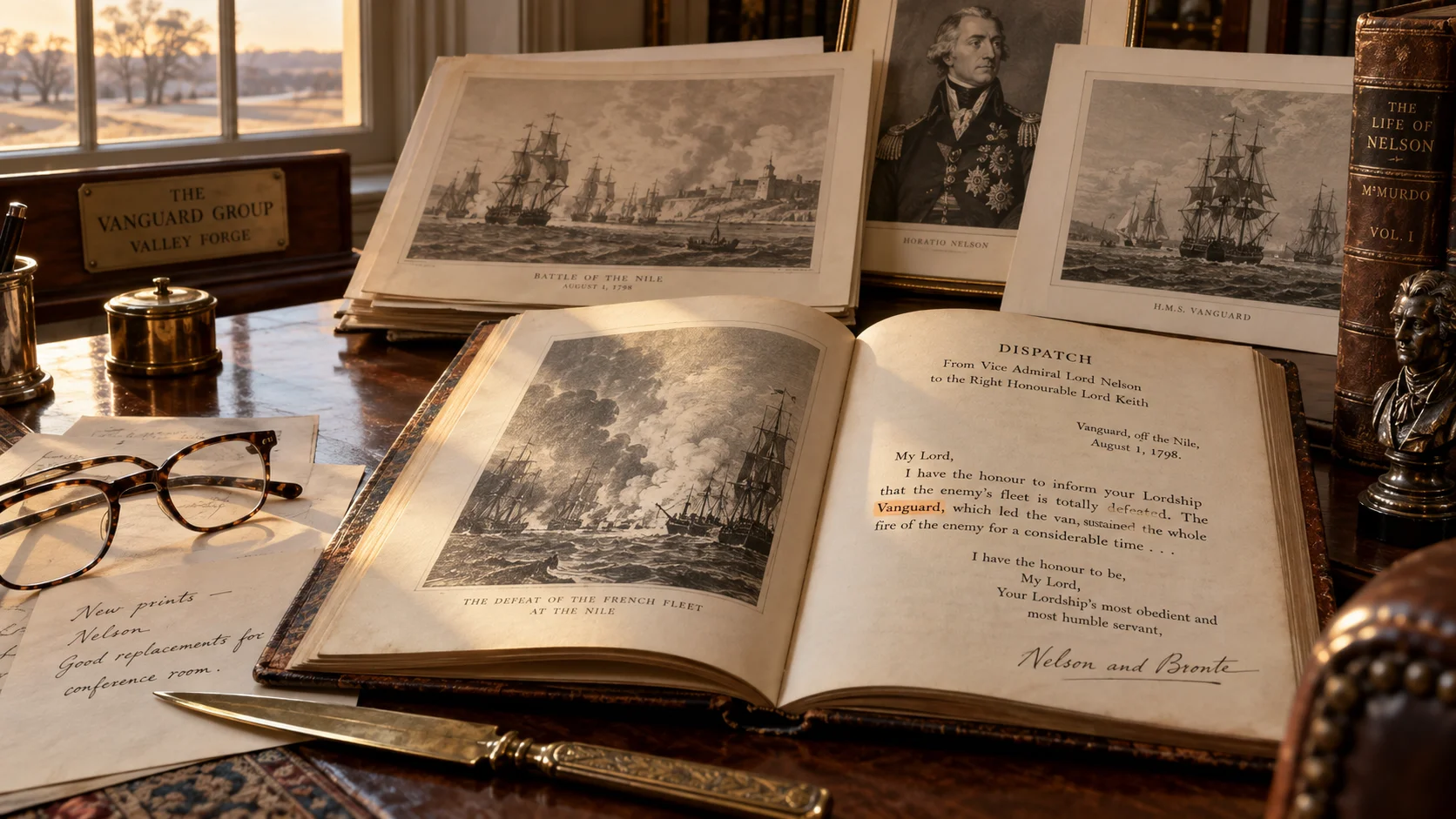
He needed a name that week, and it arrived by accident: a print dealer, repaying Bogle for prints bought to replace property lost in the Wellington split, left him a book on naval history. Inside it, Nelson's dispatch after the Battle of the Nile, and beneath the signature, the name of the ship it was written aboard: Vanguard5.

What showed that he was human after all?
His heart was failing from the start. He had his first cardiac arrest at 31, was diagnosed with arrhythmogenic right ventricular dysplasia6 at 38, and ran Vanguard for decades knowing what was coming. He received a heart transplant in 1996, at 66, and lived another 23 years.

What was the change he brought about?
By the end of 2023, passive US funds held more money than actively managed ones for the first time, a crossover7 that took roughly a decade to build. Bogle had died four years earlier, in January 2019.

What did he believe that most reasonable people around him did not?
That trying to beat the market was a service worth nothing, and that the correct response was to build a company structurally incapable of charging for it. Plenty of economists agreed with the first half; almost nobody did the second. "Don't look for the needle in the haystack. Just buy the haystack," he wrote8.

What did his trek cost him?
The obvious cost is money: roughly $80 million9, against the tens of billions the same stake would have been worth in private hands. The less obvious one came in 1999, when the company he built forced him off its own board at 70, with no exception made. "There is certainly an argument that the creator of a company deserves a tad of extra consideration," he said at the time10.

What's the takeaway?
He built an arrangement in which being wrong stayed expensive for him and cheap for everyone else. The thesis at 22 was a good idea, and good ideas are common; giving up the ownership that would've let him abandon it later is what's rare. Saying a business should treat people a certain way is easy—making that promise structurally hard to break is the harder part.
Timeline
-
1929-05-08—Born in Montclair, New Jersey, with a twin brother, David.
-
1951—Finishes a 130-page Princeton thesis, The Economic Role of the Investment Company, arguing funds should serve shareholders rather than managers. It reaches Walter L. Morgan, who hires him at Wellington on graduation.
-
1955—Made assistant to Morgan, and persuades the firm to launch a new fund.
-
c. 1960 (age 31)—First cardiac arrest.
-
c. 1967 (age 38)—Diagnosed with arrhythmogenic right ventricular dysplasia.
-
1970—Replaces Morgan as chairman of Wellington's mutual funds.
-
1974—Dismissed from Wellington for approving a merger he later called his biggest career mistake; the split leaves him running fund administration, barred from managing client money, and establishes Vanguard, owned by its own funds rather than by him.
-
Late summer 1974—A print dealer calls at Valley Forge and leaves a gift, a book on naval history. Inside it: Nelson's dispatch after the Nile, and the ship it was written aboard.
-
1974—Paul Samuelson publishes "Challenge to Judgment," arguing that picking superior managers is largely futile. Bogle later calls him "in many respects my mentor."
-
1976-08-31—First Index Investment Trust launches. It sought $50–150 million and raised a little over $11 million—Bogle: "an abject failure." It could afford 280 of the 500 stocks. The industry calls it Bogle's Folly and indexing un-American.
-
1976—The underwriters propose returning the money. Bogle: "I said, hell no."
-
1996—Heart transplant, at 66.
-
1999—Forced off Vanguard's own board at 70 under its mandatory retirement policy, despite founding the company.
-
2007—The Little Book of Common Sense Investing—the haystack line.
-
2019-01-16—Dies in Bryn Mawr, Pennsylvania, worth about $80 million—not billions, by the structure he chose.
Side notes
-
Wellington Fund—Walter L. Morgan founded it in 1928, one of the first balanced mutual funds in the U.S.; the firm formally incorporated in 1933. Learn more ↩
-
Samuelson's challenge—Published in the debut issue of the Journal of Portfolio Management, the essay urged that some large foundation, or the American Economic Association itself, set up a fund that simply tracked the S&P 500. Bogle later called it "an express challenge for somebody, somewhere to start an index fund"—and decided his newly mutual company ought to be the one to answer it. Learn more ↩
-
Vanguard's ownership—The company's own account contrasts itself with "most other mutual fund management companies," which are owned by outside stockholders expecting a profit; being owned by its own funds, it says, is what let it cut fees more than 2,000 times since 1975. Industry watchers now call the ripple effect on rivals' prices "the Vanguard Effect." Learn more ↩
-
Bogle's Folly—Vanguard's own history page still recalls the reception: competitors dismissed the 1976 launch as "un-American" and "a sure path to mediocrity." Learn more ↩
-
HMS Vanguard—The ship flew Nelson's flag at the 1798 Battle of the Nile; Bogle found its name in a book on naval history a print dealer left him just after the firm's founding. Learn more ↩
-
Arrhythmogenic right ventricular dysplasia—An inherited heart disease that disrupts the connections between heart-muscle cells, causing irregular heartbeats and, in Bogle's case, a first cardiac arrest at 31. Learn more ↩
-
The passive/active crossover—Passive US mutual funds and ETFs held about $13.3 trillion at the end of 2023 against $13.2 trillion for active funds, according to Morningstar data, up from roughly a quarter of the market a decade earlier. Learn more ↩
-
The Little Book of Common Sense Investing—Published in 2007, it's the fullest statement of the case he'd been making since his Princeton thesis, written for ordinary investors rather than economists. Learn more ↩
-
His $80 million—A fraction of the fortune a conventional ownership stake in the company he built would have made him. Learn more ↩
-
Forced off his own board—Vanguard's mandatory retirement age for directors, then and now, is 70; the policy applied to Bogle without exception in 1999, and press coverage at the time described the relationship with his handpicked successor as strained afterward. Learn more ↩