- The singer voicing the film's lead character used to be a K-pop trainee herself.
- One of its co-writers moonlights as a lyricist for a West End stage musical.
- David Guetta released his own remix just three weeks after the original came out.

Intro.
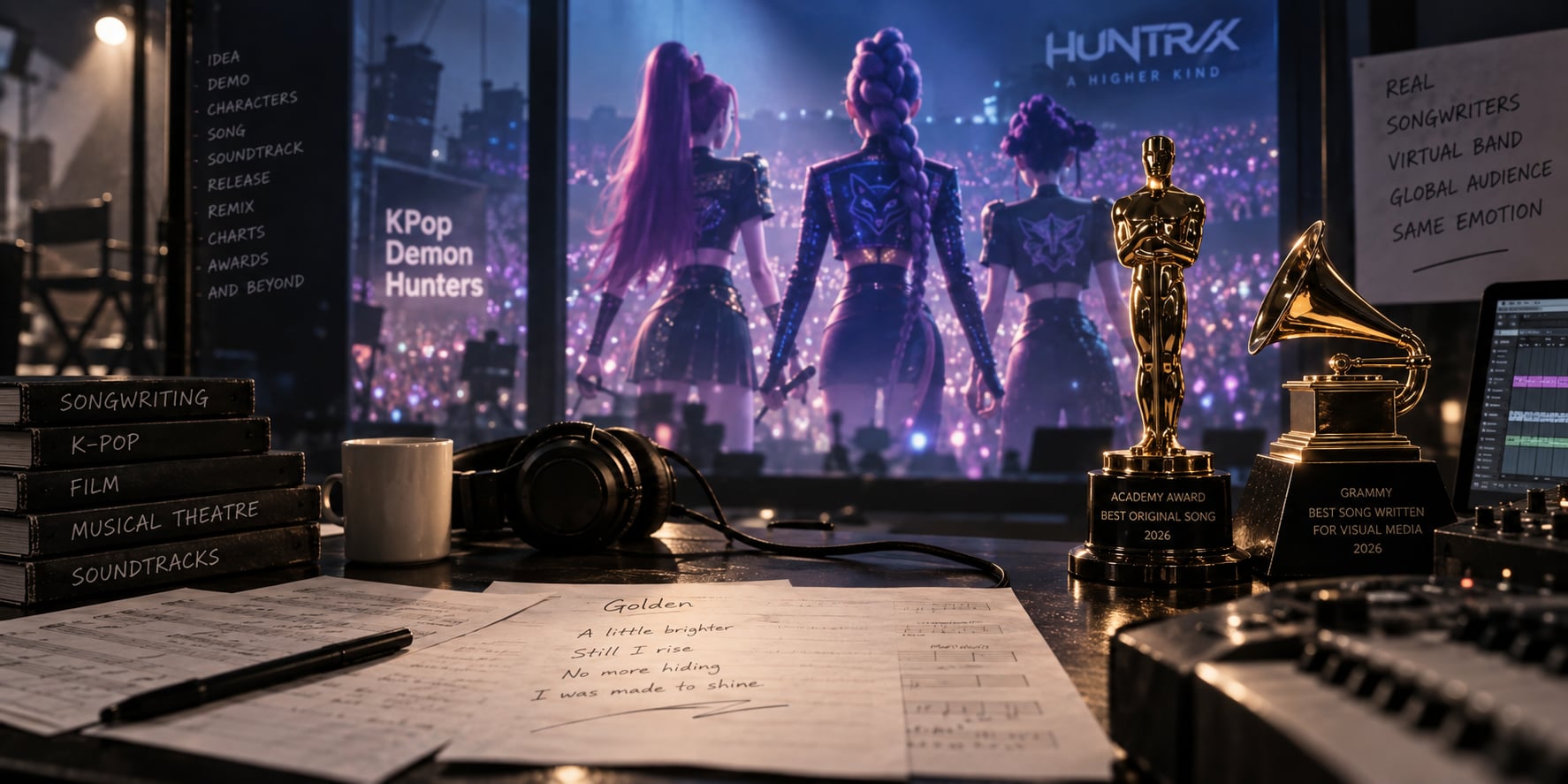
"Golden" doesn't have a band behind it so much as a film department. In March 2026, the song won the Academy Award for Best Original Song—the first Oscar ever given to anything built around a K-pop act, real or invented. HUNTR/X, the trio credited on the single, exists only inside Netflix and Sony's animated feature KPop Demon Hunters, and it has never toured, sat for an interview, or existed for one second outside a frame of animation. The song won the awards. The group collecting them has never been real.

Cue the track.
Written by EJAE, Mark Sonnenblick1, and five others for the film's lead character, Rumi, the song plays as her private confession dressed up as a pop chorus, a device borrowed from musical theater and smuggled into a pop single. Released July 4, 2025 on the film's soundtrack, it spent 18 non-consecutive weeks at No. 1 on the Billboard Global 200, at the time the longest run any song by an animated act had managed on that chart.

Things you didn't know.
EJAE also sings Rumi's part on screen, which means the song's lead writer and the voice performing it in the film are the same person. She's also the songwriter behind one of the last decade's other big K-pop crossovers2: a 2019 single that won Song of the Year at South Korea's Gaon Chart Awards. Director Maggie Kang has credited EJAE's early demos, made years before the rest of the cast was set, with getting the film greenlit in the first place.

The songwriter's gamble.
Before any of that, EJAE spent a decade as an idol trainee under SM Entertainment3, starting at age 11 and never debuting. She aged out of the system in 2011 and rebuilt herself at NYU's Tisch School of the Arts, writing hits for other people's careers instead of her own. That history shaped the real craft problem behind "Golden": Sonnenblick has said the hardest part was writing a bridge that could carry Rumi's private vulnerability without breaking the song's shape as a radio-ready pop chorus. Get that balance wrong, and the song satisfies neither job.

The session, and the takes not kept.
The album credits list seven writers and four producers, including Teddy Park4, the producer behind most of BLACKPINK's biggest singles, working here on a cartoon's soundtrack instead of a real act's comeback. Sonnenblick and executive producer Ian Eisendrath have both called themselves "musical theatre nerds," and that sensibility runs through the credit list: a K-pop record built partly by people whose day jobs sit in theater and film scoring. No scrapped verse or fought-over line has surfaced in reporting; the harder work happened at the writing-room level, matching form to a character's arc rather than in the vocal booth.

Where it came from.
"Golden" has no earlier sample or interpolation behind it; it was built from the ground up for a film whose music department started years before a frame of animation existed, with EJAE attached since around 2019. What it generated afterward is a small remix economy of its own. Three weeks after release, David Guetta5 issued his own version, marketed explicitly as a bid for song of the summer—proof a soundtrack cut had outgrown its movie.

The invisible hand.
Netflix and Sony funded the film's songwriting department the way a label backs a real artist, hiring proven hitmakers rather than treating the soundtrack as an afterthought, and the bet paid out well past a typical movie tie-in. Publishing royalties split across the song's seven credited writers by their negotiated shares; recording revenue, plus any earnings tied to the Guetta version, flows to the labels actually holding the rights, Republic among them, since there's no touring artist to collect a performer's cut. That's the part with no real precedent: an act nominated for, and winning, music's biggest awards has no career of its own to advance, no tour to route the money into, and no members who see a dime beyond whatever fee they were paid.
By the numbers.
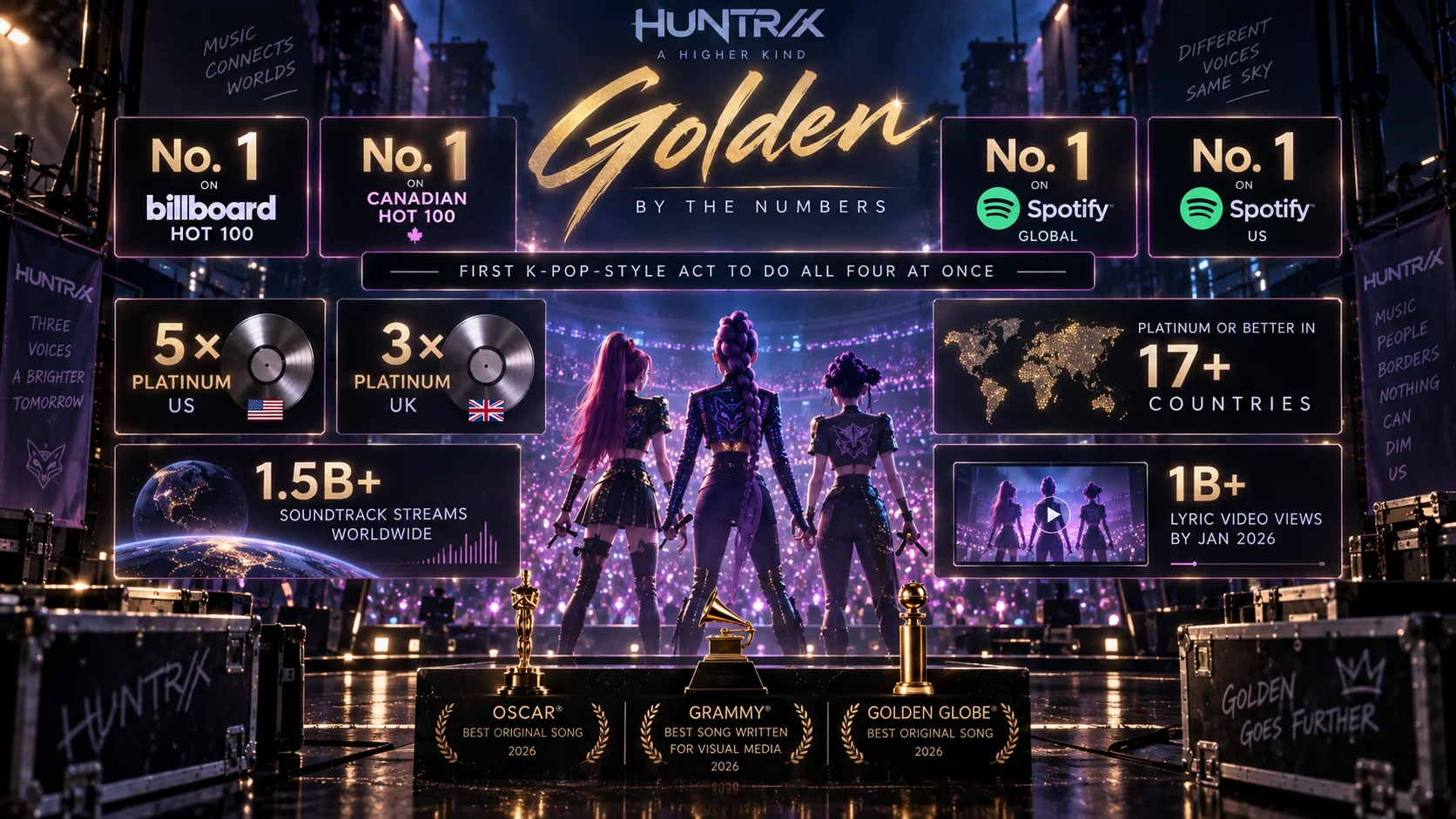
As of September 2026, the song has also topped the Billboard Hot 100, the Canadian Hot 100, and Spotify's Global and US charts at once, a first for a K-pop-style act. It's 5× platinum in the US, 3× platinum in the UK, and platinum or better in at least 17 other countries; the soundtrack has logged 1.5b+ streams worldwide, and its lyric video passed 1b+ YouTube views in January 2026. The trophy case now includes the Oscar, a Grammy for Best Song Written for Visual Media, and a Golden Globe for Best Original Song—the first competitive wins of their kind for anything built around a K-pop act.

Why it endures.
Awards attention fades, and a summer remix even faster; what won't fade as easily is the underlying model: a media company backing a movie's original song department the way it would a real artist's rollout, and getting a genuine, sustained hit rather than a soundtrack curiosity. HUNTR/X will never play an arena show, sit for a late-night interview, or do any of the things an act with a Grammy and an Oscar usually goes on to do next. The song keeps collecting streams anyway.
Note: "Golden"'s certification tally and awards count were still climbing as of this piece's writing (September 2026) and should be re-verified against RIAA.com, BPI, and the relevant award bodies at final lock.
Side notes
-
Mark Sonnenblick — He's currently a lyricist on the West End's stage adaptation of The Devil Wears Prada, and has described himself and the film's executive producer as "musical theatre nerds" who built the song's bridge specifically to work as an in-story confession. Learn more ↩
-
Psycho — EJAE wrote "Psycho" for Red Velvet's 2019 comeback, which won Song of the Year at South Korea's Gaon Chart Music Awards and went platinum domestically, years before she ever pitched a note for an animated film. Learn more ↩
-
EJAE — Born Kim Eun-jae in Seoul, she began idol training at 11 and aged out of SM Entertainment's system in 2011 without ever debuting, rebuilding her career at NYU's Tisch School of the Arts before returning to K-pop as one of its most in-demand songwriters. Learn more ↩
-
Teddy Park — Park is The Black Label's chief producer and the primary hitmaker behind BLACKPINK's biggest singles, including "Ddu-Du Ddu-Du" and "Kill This Love"; "Golden" marked a rare outside project for a producer who mostly works with one act. Learn more ↩
-
David Guetta — His version, released via Visva/Republic on July 25, 2025, arrived as a deliberate push to keep "Golden" in rotation through the rest of the summer, not as an organic fan-driven remix. Learn more ↩