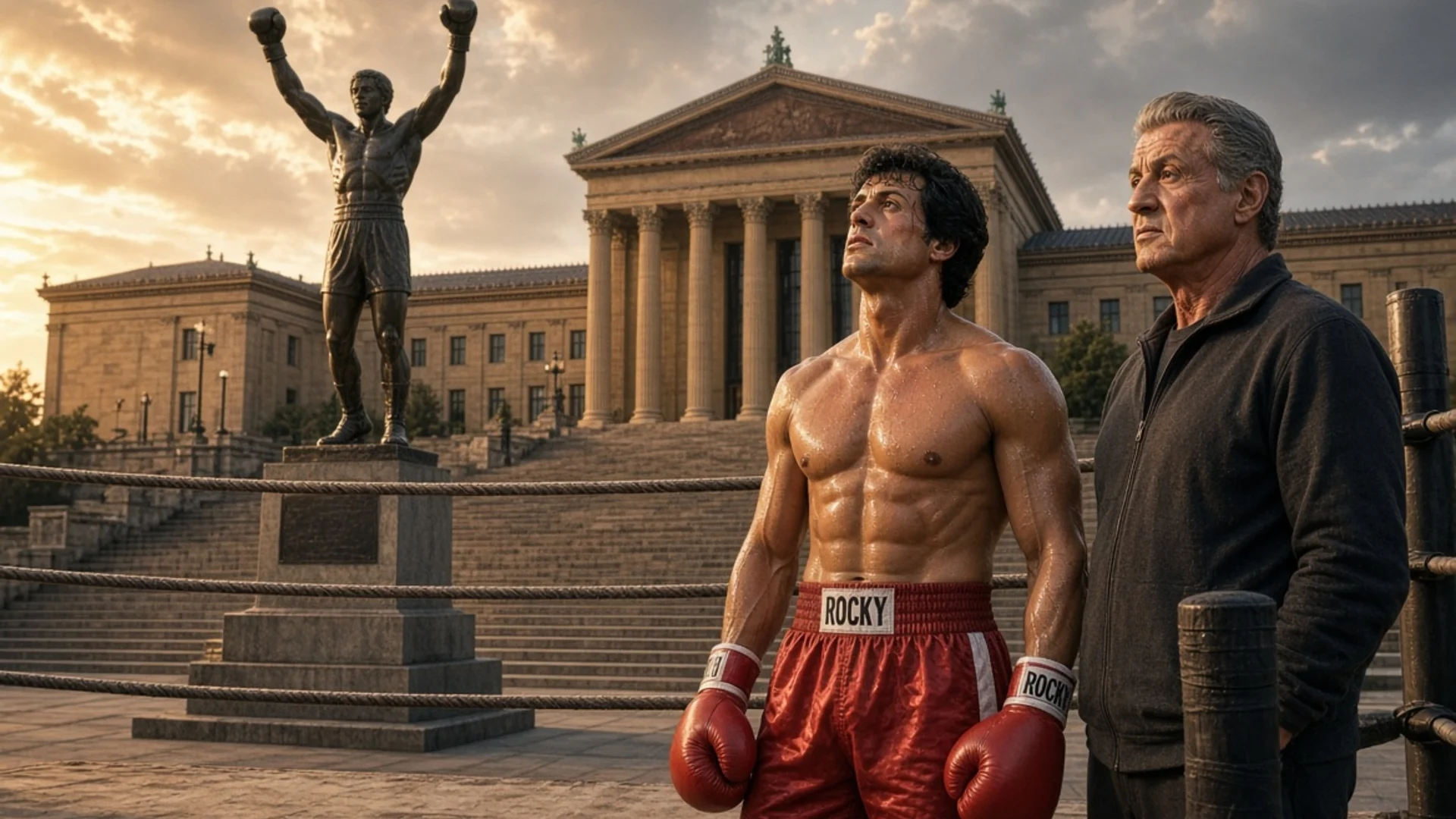
- Fifty years later, Rocky returns to theaters as Stallone's origin story gets its own film.
- A brand-new camera rig, the Steadicam, carried that famous run up the museum steps.
- Made in 28 days for about $1m, it grossed $225m worldwide.
Intro.
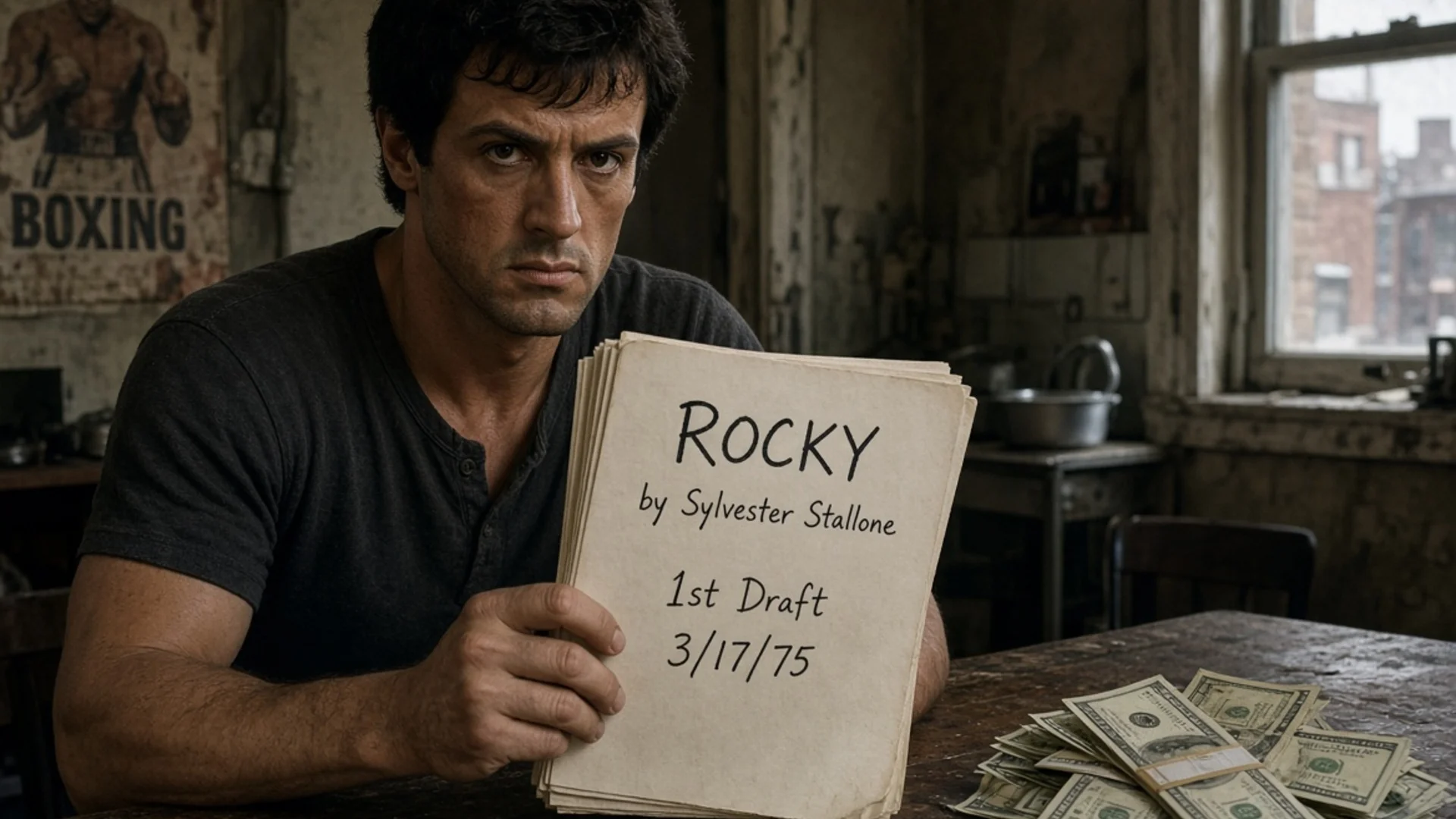
In 1975, Sylvester Stallone had $106 in the bank and a boxing script that studios wanted, as long as a bigger star played the lead. He kept saying no. Fifty years later, Rocky is back in theaters1 as a 4K remaster from November 7 to 11, and the story of that refusal has become a movie of its own. I Play Rocky2 opens November 6. The original cost about $1m, made $225m, and won Best Picture. The long shot paid off.
Here's the plot.
Philadelphia, 1975. Rocky Balboa is a club fighter going nowhere, earning more as muscle for a loan shark than he does in the ring. When heavyweight champion Apollo Creed loses his opponent for a Bicentennial title fight, he picks an unknown from the city's gyms as a publicity stunt, and the name he likes is the Italian Stallion. Rocky trains, falls for Adrian, the painfully shy clerk at the neighborhood pet shop, and sets himself one goal. He doesn't expect to win. He wants to go the distance.
Things you didn't know.
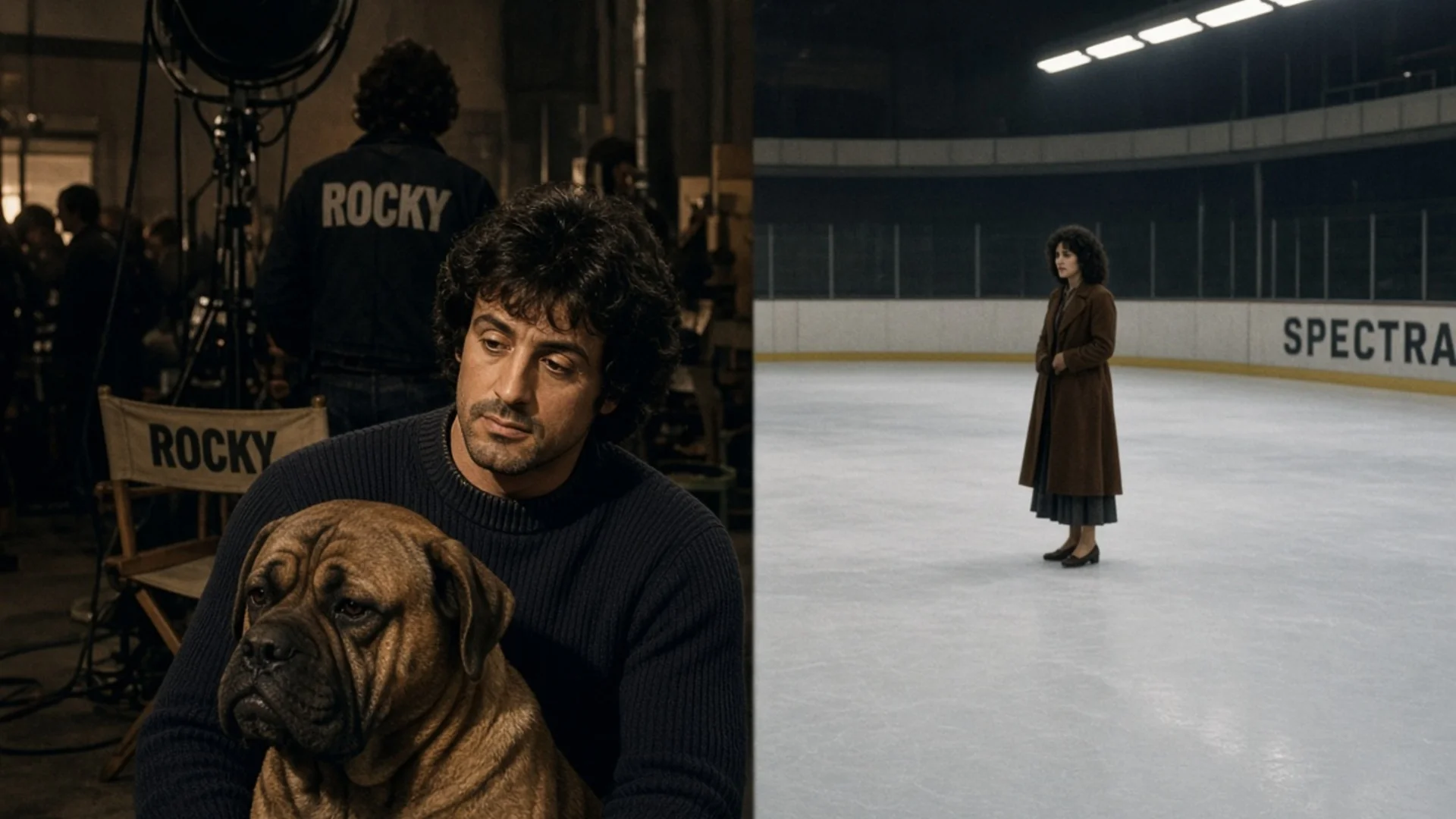
The fight poster in the arena gets Rocky's shorts the wrong color, and his robe arrives too big. Both mistakes made it into the script, with the promoter shrugging that it doesn't really matter. The production was a family affair: Stallone's father rings the bell between rounds, his brother Frank sings on a street corner, and Butkus, Rocky's dog, was Stallone's own bullmastiff. Even the ice-skating date was a budget call. The rink is empty, reportedly because there was no money for extras.
The director's gamble.
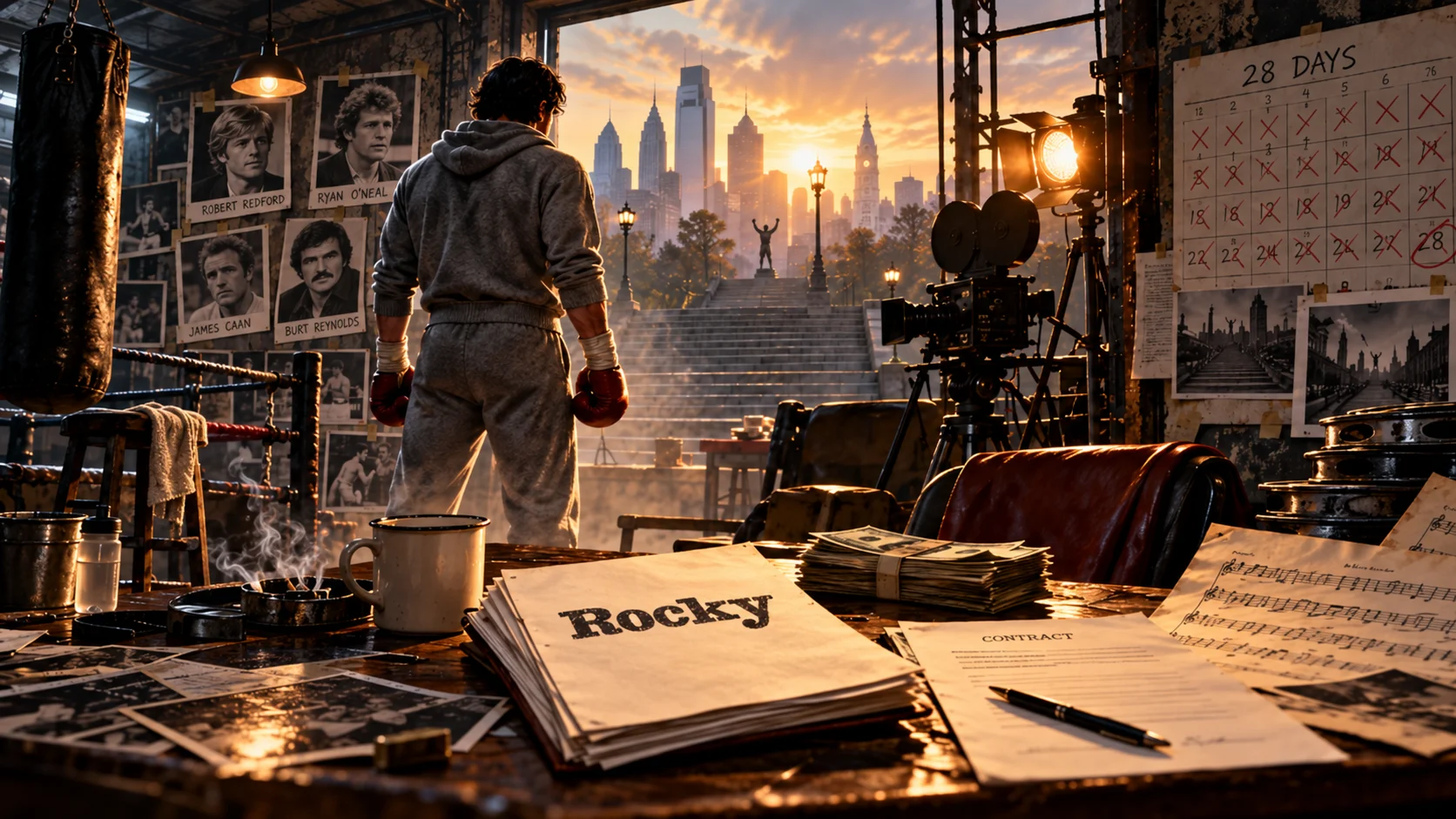
United Artists liked the script and wanted a star to carry it. Robert Redford, Burt Reynolds, James Caan, and Ryan O'Neal were all floated. Stallone refused to sell unless he played Rocky himself, even as the offers climbed as high as $275,000. Producers Irwin Winkler and Robert Chartoff took the risk, agreeing to make the film for about $1m and guaranteeing its completion. Director John G. Avildsen got a 28-day schedule. Bill Conti's score supplied the swagger the budget couldn't, and its theme, "Gonna Fly Now"3, became a No. 1 hit.
The cast, and the roads not taken.
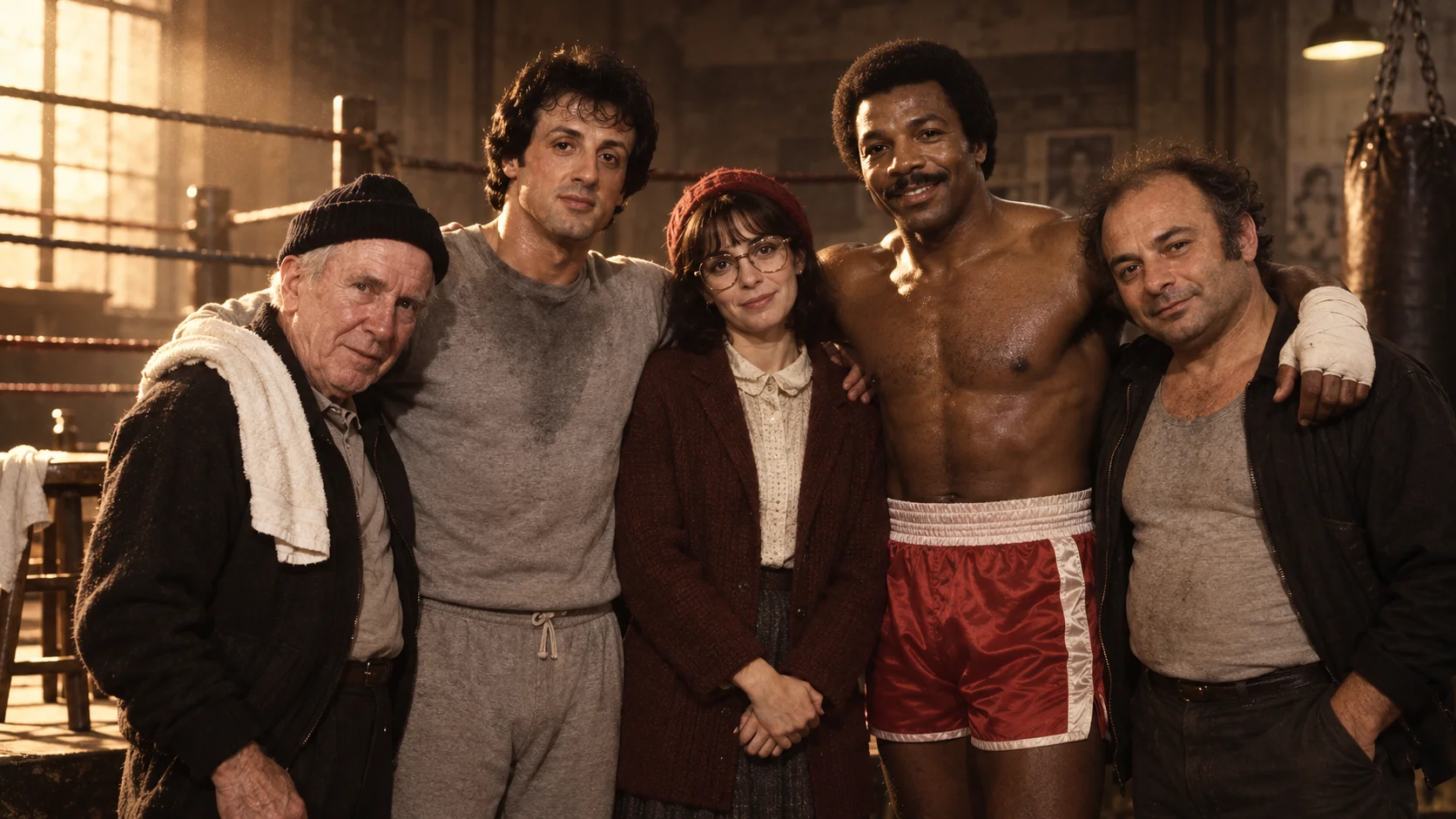
Talia Shire played Adrian, Burt Young her brother Paulie, Burgess Meredith the trainer Mickey, and Carl Weathers the champion. Adrian nearly went to someone else: Carrie Snodgress was the first choice until money talks fell through, and Susan Sarandon was judged too pretty for the part. Ken Norton, a real heavyweight, was sought for Apollo before he pulled out. Weathers, a former NFL linebacker, won the role after telling Stallone at his audition that he could do better with a real actor to read against. The film earned four acting nominations, and Stallone became only the third person nominated for acting and writing in the same year4.
Where it came from.
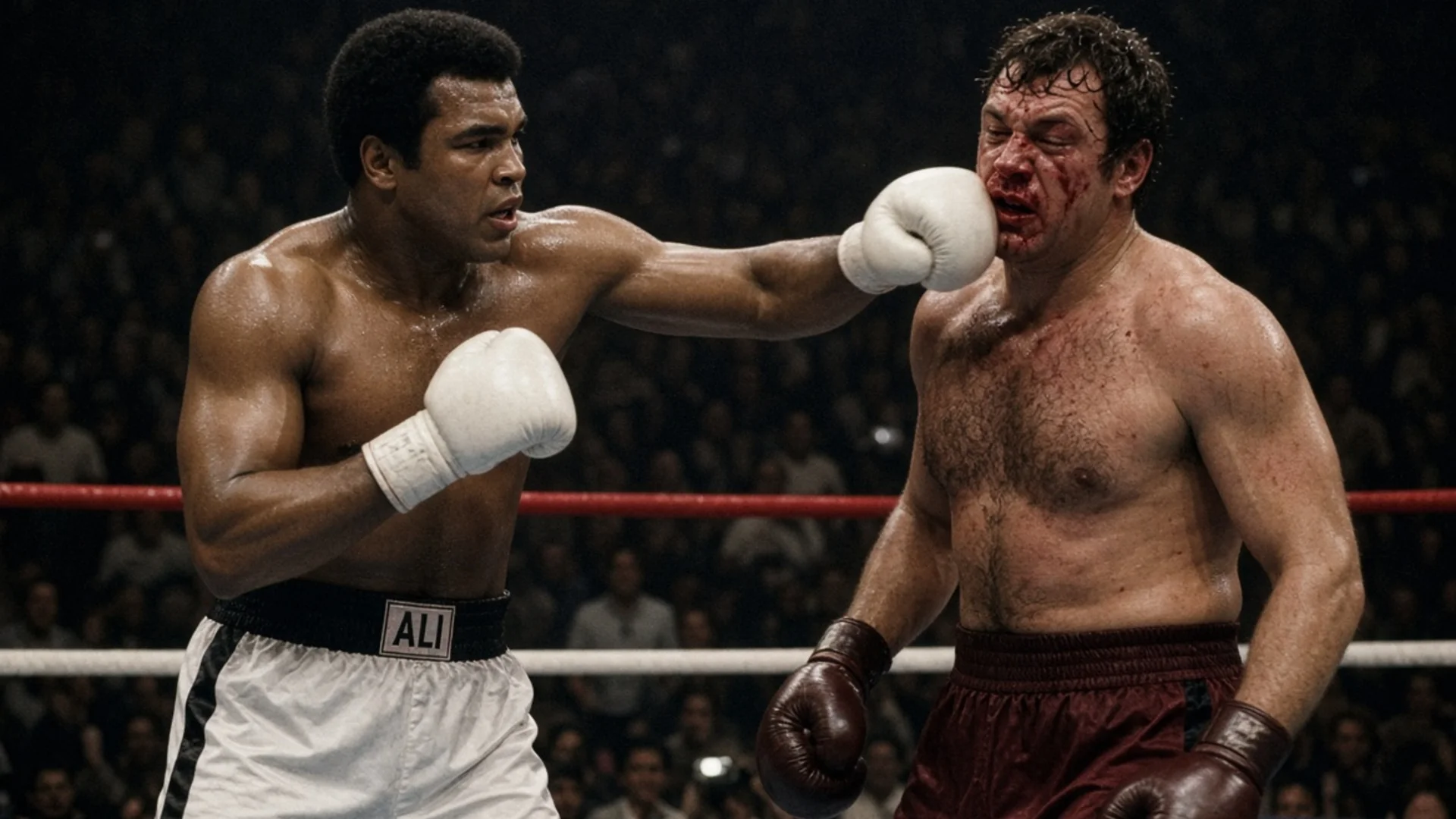
The spark was Muhammad Ali's March 24, 1975, title defense against Chuck Wepner5, a journeyman from New Jersey who lasted into the 15th round before the referee stopped it. Stallone wrote a first draft in about three and a half days. The story kept the underdog and dropped the ending everyone expected. Rocky loses the decision and wins the point.
The tech behind the tale.
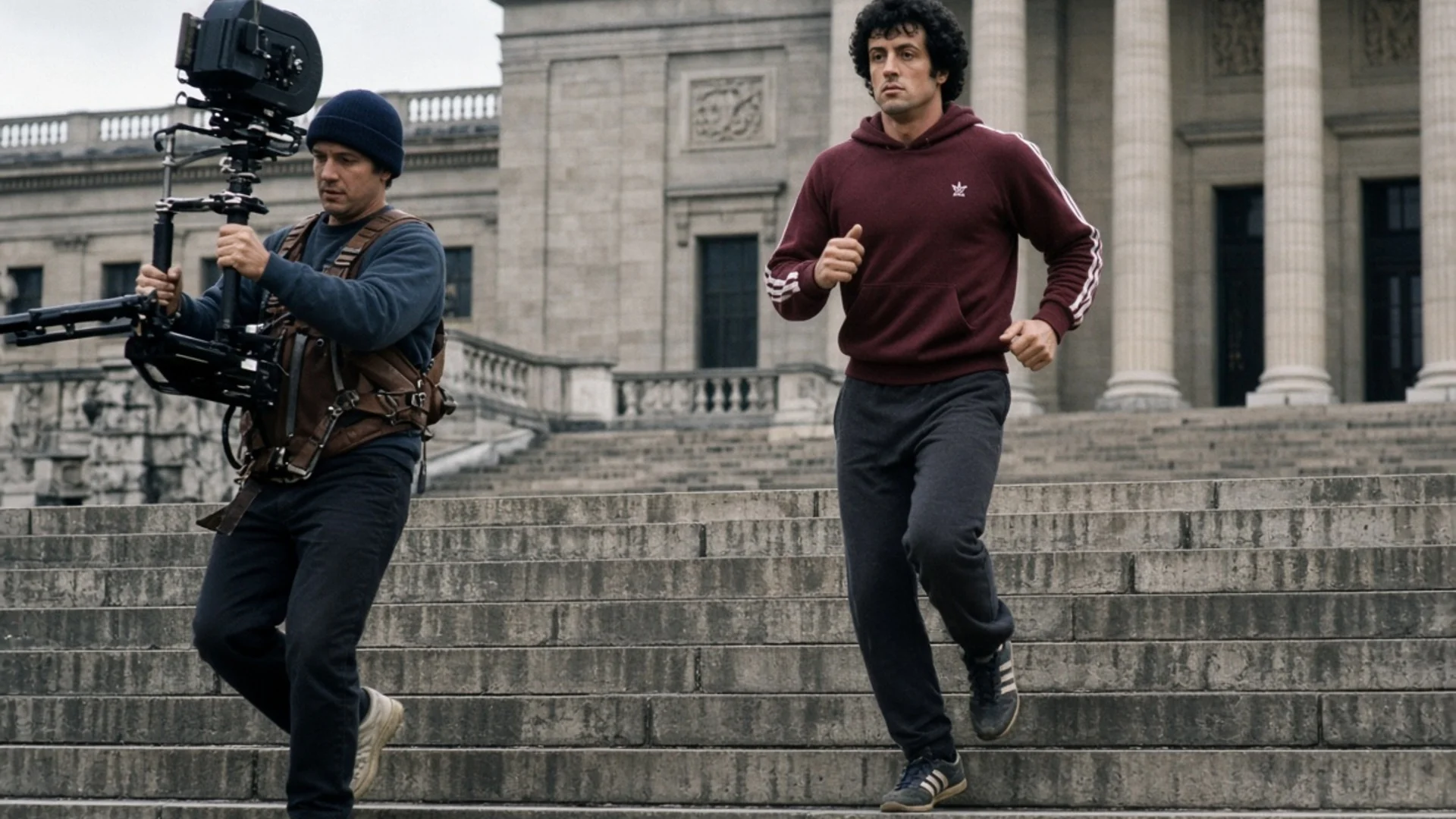
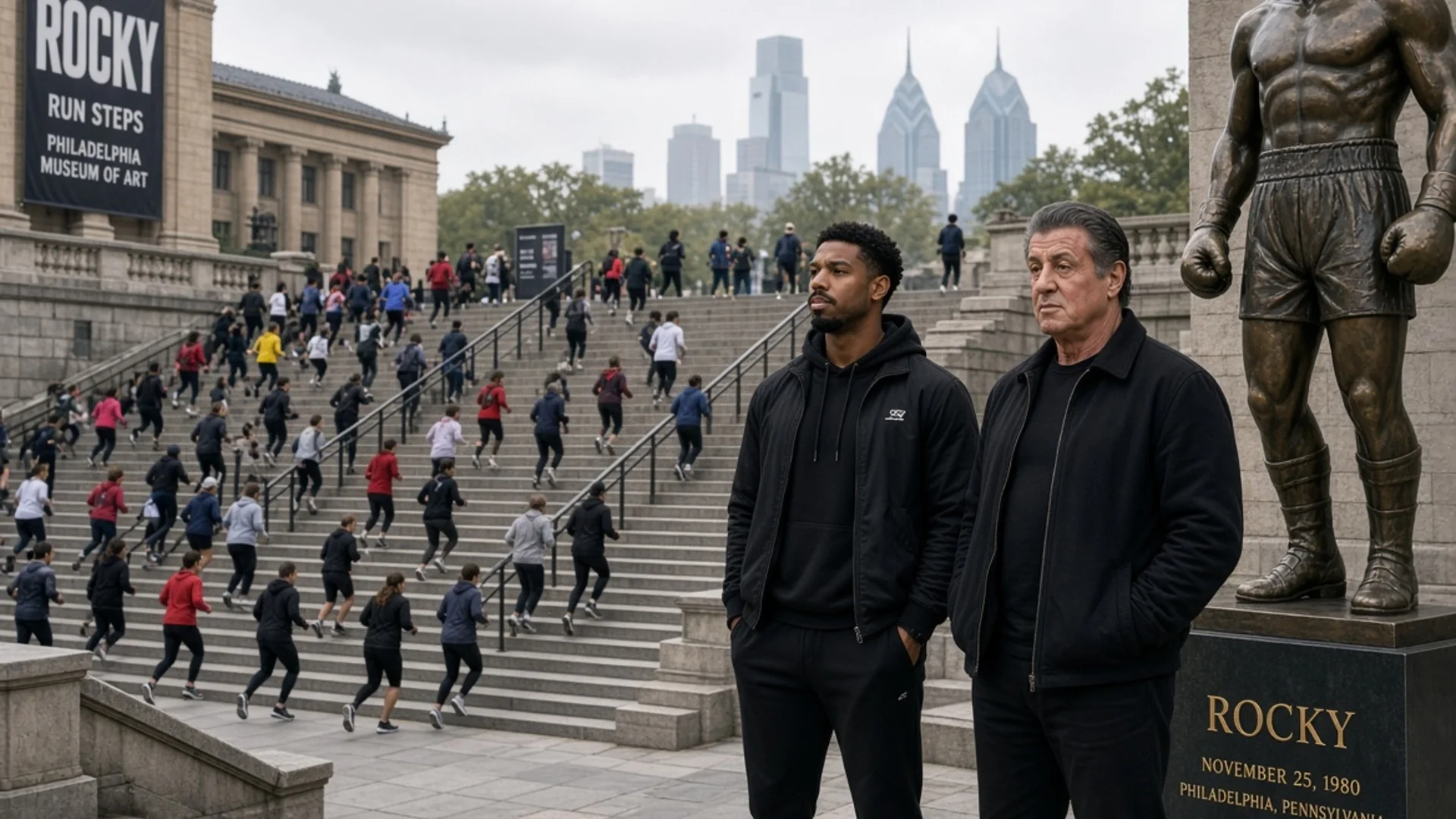
The run up the 72 steps of the Philadelphia Museum of Art depended on a camera rig barely a year old. Garrett Brown's Steadicam6 let an operator run alongside an actor and still get a smooth, floating picture, with no tracks or dolly required. Rocky was only its third feature, after Bound for Glory and Marathon Man, and Brown operated it himself. He already knew the location. His demo reel, the one that got Avildsen's attention, ended with him running up those same steps.
The invisible hand.
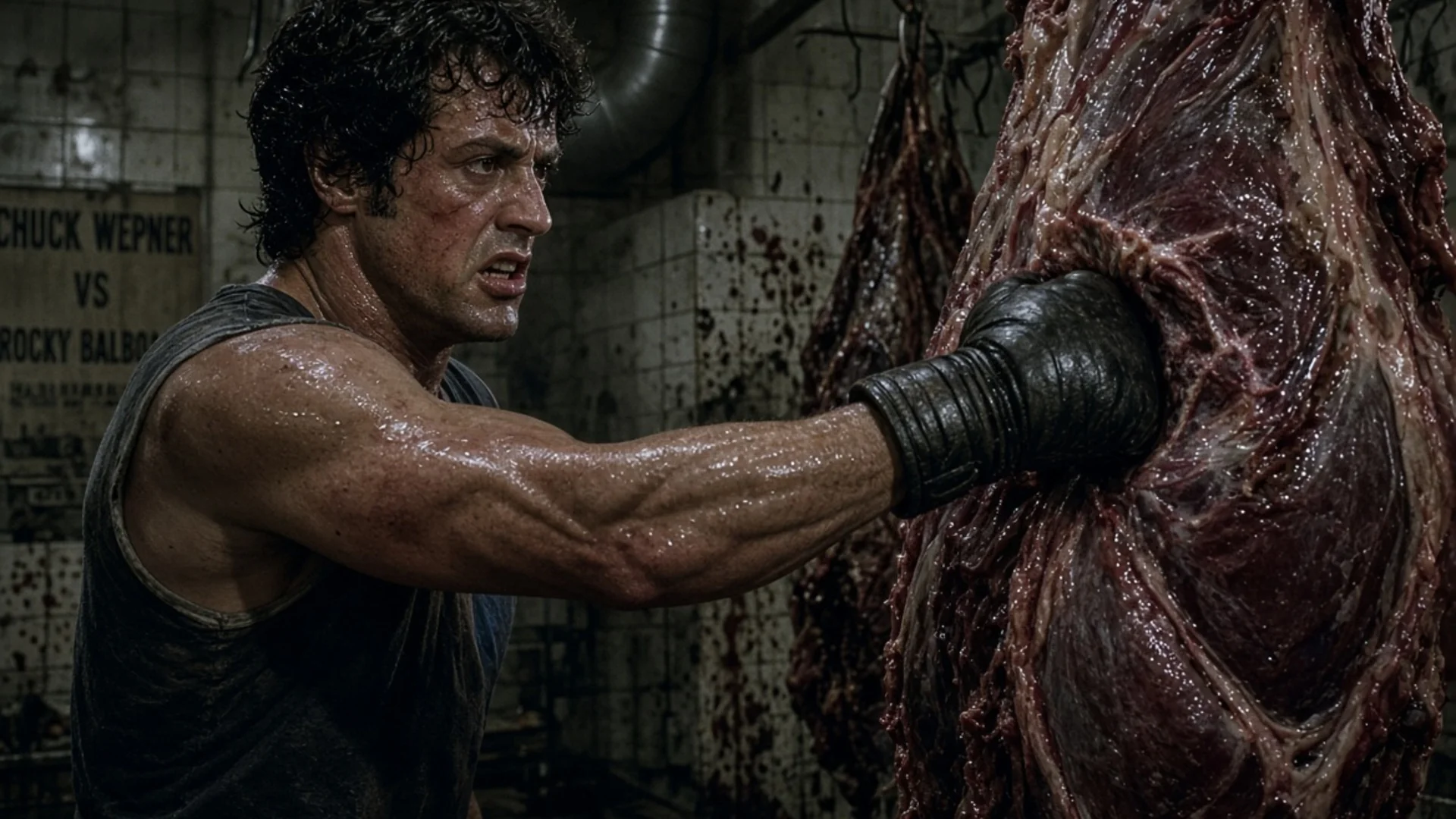
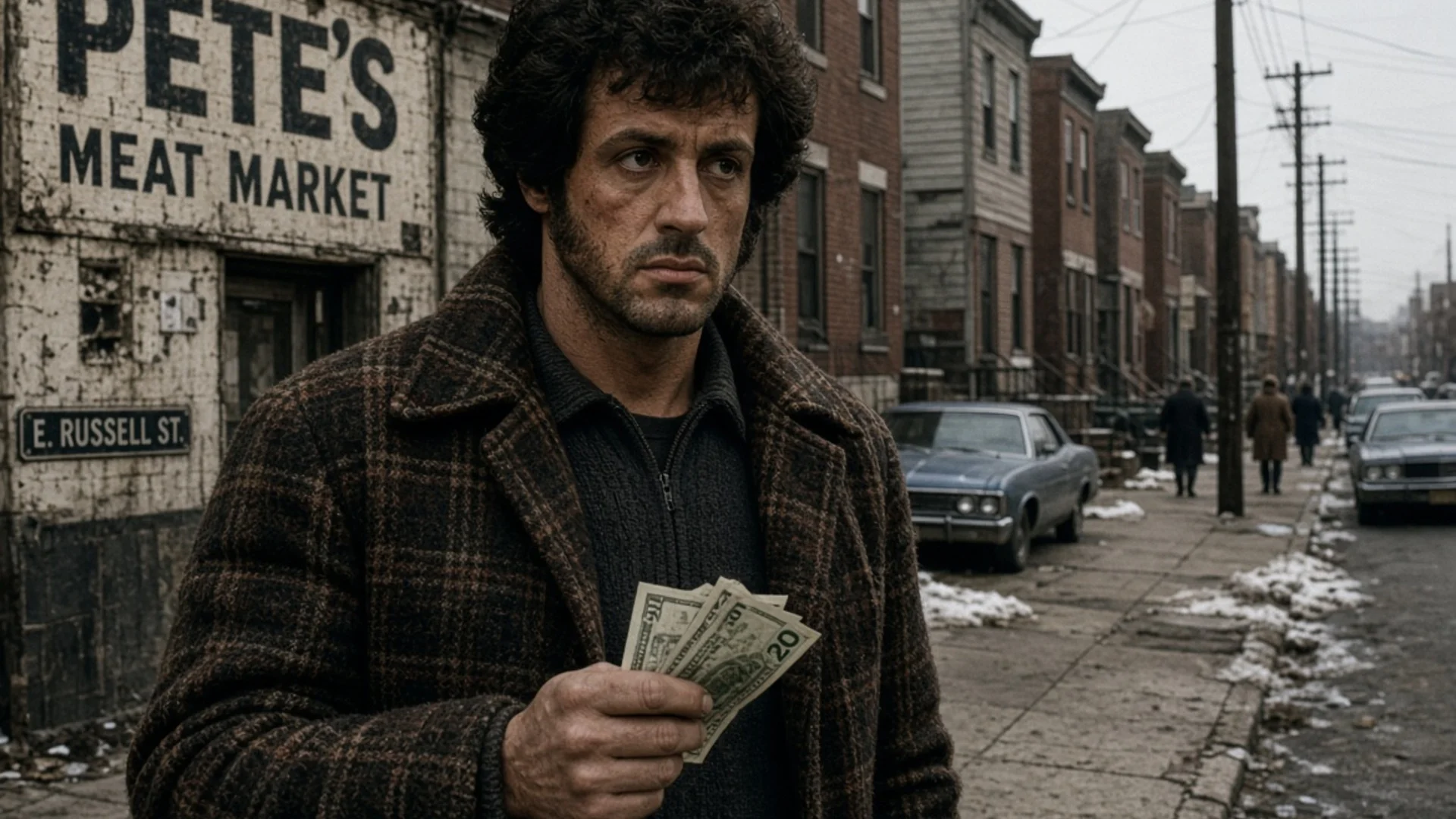
Money runs through every scene. Rocky lives on club-fight scraps and the cash he collects for loan shark Tony Gazzo, a job he's too soft to do well. Apollo's offer flips that economy: a $150,000 purse, about $888,000 today, handed to an unknown because a nobody with a good nickname sells more tickets than a contender. The setup mirrors the fight that inspired it, where Ali took home $1.6m and Wepner $100,000. Rocky's training runs on the cheapest resources in Philadelphia: raw eggs, public stairs, and sides of beef in a meat locker.
By the numbers.
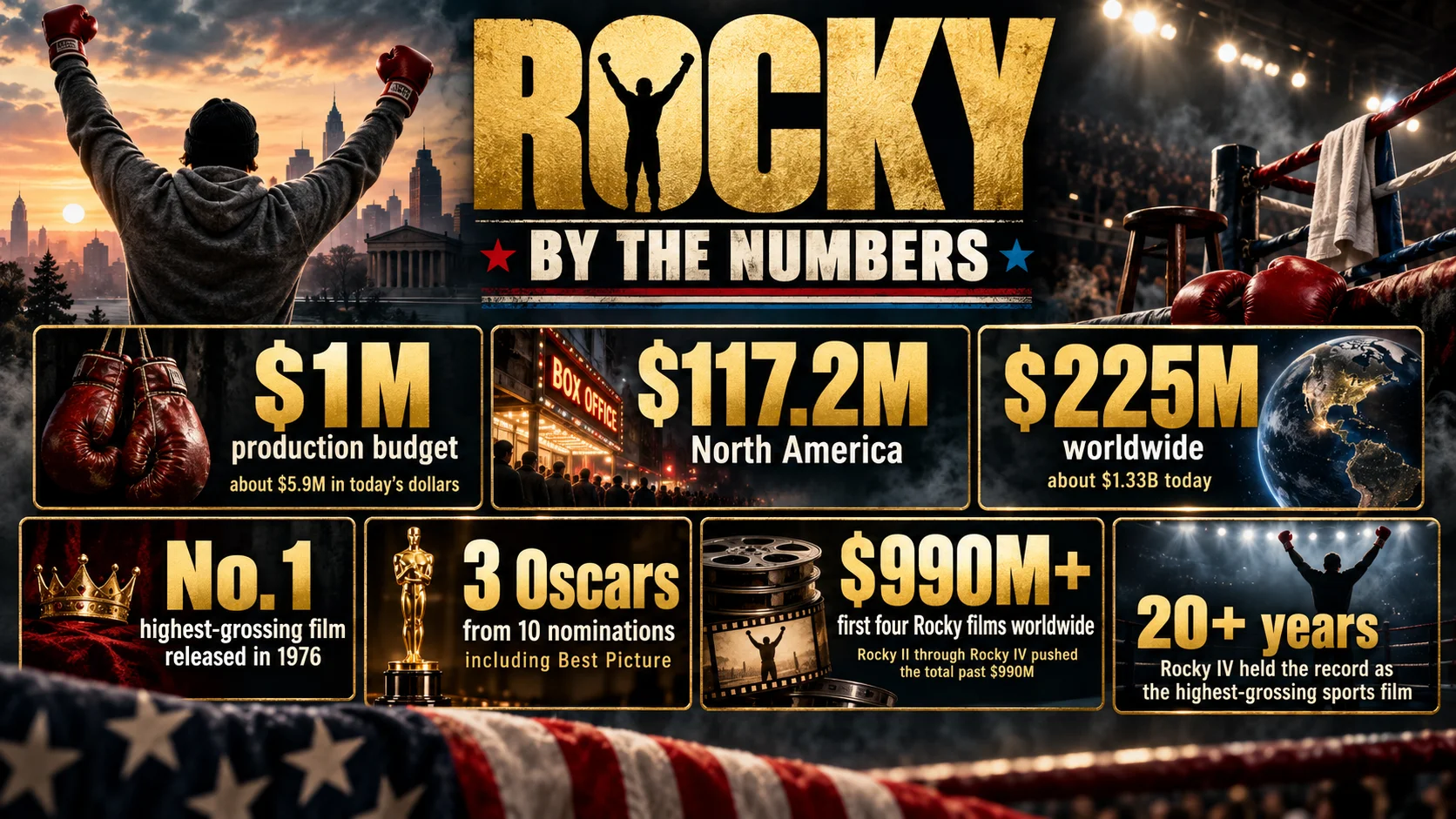
Rocky cost about $1m to make, roughly $5.9m in today's dollars, and earned $117.2m in North America and $225m worldwide, about $1.33b today. It was the highest-grossing film released in 1976 and won three Oscars from 10 nominations, including Best Picture. The sequels kept the money coming. Rocky II through Rocky IV pushed the first four films past $990m worldwide, and Rocky IV held the record as the highest-grossing sports film for more than 20 years7.
Figures adjusted to 2026 dollars using BLS CPI (~5.9x).
Why it endures.
The story never stopped being retold. Ryan Coogler's Creed8 handed the franchise to Apollo's son in 2015 and earned Stallone another Oscar nomination for playing Rocky. The museum steps became a pilgrimage9, and the Library of Congress added the film to the National Film Registry10 in 2006. Now Rocky is back on the big screen in 4K, and I Play Rocky returns to where it all started: an unknown writer who wouldn't sell. Fifty years on, the long shot is still collecting.
Side notes
-
Rocky 50 — Fathom Entertainment is bringing a 4K remaster of Rocky to theaters November 7–11, 2026, with an exclusive featurette from I Play Rocky and, at some theaters, a popcorn bucket shaped like the museum steps. Watch the trailer · Get tickets ↩
-
I Play Rocky — Peter Farrelly's dramatized account of how Stallone got Rocky made stars Anthony Ippolito as the young actor. It premiered at the Toronto International Film Festival in September 2026 to a standing ovation, with Stallone's blessing, and opens in select theaters November 6 and nationwide November 20. Watch the trailer · Learn more ↩
-
"Gonna Fly Now" — Bill Conti's training theme reached No. 1 on the Billboard Hot 100 in July 1977 and earned an Oscar nomination for Best Original Song. Listen on Spotify · Learn more ↩
-
A rare double — Before Stallone, only Charlie Chaplin, for The Great Dictator, and Orson Welles, for Citizen Kane, had been nominated for acting and writing in the same year. Learn more ↩
-
Chuck Wepner — Wepner was stopped in the final minute of the 15th and last round against Ali. He later sued Stallone over the film's origins and settled in 2006 on undisclosed terms. Learn more ↩
-
The Steadicam — Garrett Brown invented the stabilizer in 1975 and later received a 1978 Academy Award of Merit for it, shared with the engineering team at Cinema Products, the company that brought it to market. Learn more ↩
-
Rocky IV**'s record** — Guinness World Records credits Rocky IV, which grossed about $300m worldwide, with holding the sports-movie box-office record for more than 20 years. Learn more ↩
-
Creed — Michael B. Jordan stars as Adonis Creed, and Stallone won a Golden Globe for the first film. The three Creed films grossed about $665m worldwide, and Jordan directed the third. Learn more ↩
-
The Rocky Steps — Visitors still reenact the run up the museum's 72 steps, and the bronze Rocky statue linked to them began as a prop for Rocky III that city officials once refused to call art. Learn more ↩
-
National Film Registry — Each year the Library of Congress selects 25 films it judges culturally, historically, or aesthetically significant and preserves them for the long term. Learn more ↩